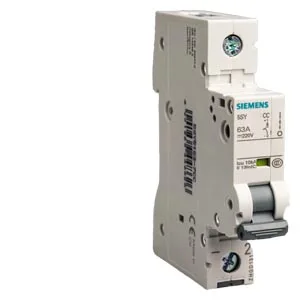
It is designed for universal current operation — 220 V DC and 230/400 V AC — with a breaking capacity of 10 kA at DC per IEC 60947-2. This is the variant explicitly built for railway applications, carrying vibration resistance tested to IEC 60068-2-6 (±1 mm at 5–25 Hz; 50 m/s² at 25–150 Hz) and an ambient temperature range of -40 °C to +75 °C.
DC rating is the headline — here is what it means
DC arcs are harder to extinguish than AC arcs because there is no natural zero-crossing. The 5SY5106-6CC11 uses a blowout magnet system to stretch and cool the arc until it extinguishes. For a 6 A B-curve breaker, 10 kA DC interrupting rating covers most battery banks, DC bus supplies, and railway auxiliary circuits. The AC side is rated 230/400 V with the same 10 kA — the B-curve trips between 3 and 5 times rated current (18–30 A), protecting semiconductor loads and long cable runs where inrush is minimal. For motor circuits or transformer primaries with higher inrush, a C or D curve would be needed; this part stays in its lane.
At 18 mm wide (1 MW) and 76 mm deep (70 mm installation depth behind the panel), this breaker fits standard 18 mm DIN-rail slots. The polarity of the DC supply must be observed (the terminal marking indicates line and load), unlike AC where orientation is arbitrary. Auxiliary contacts, shunt trips, and under-voltage releases can be snapped onto the right side via the product extension interface.