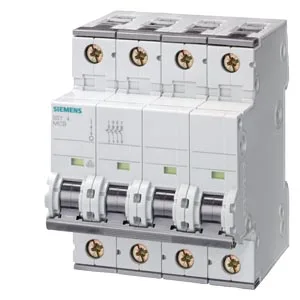
The Siemens 5SY7414-7 is a 4-pole miniature circuit breaker from the SENTRON series, designed for AC circuits at 400 V and 50/60 Hz. Its C tripping characteristic means it handles moderate inrush currents — typical for motor starters, small transformers, and lighting banks in industrial control panels — without nuisance tripping. The rated current is 0.3 A at 35 °C ambient, and it derates linearly to 0.25 A at 60 °C. That 0.3 A figure is the continuous current it can carry without tripping in a 35 °C panel. If your enclosure runs hot — say 50 °C — you're limited to 0.27 A continuous. This is a protection device for a very low-current branch, not a main feeder.
Mounting position is unrestricted. The combined terminal design at both top and bottom accepts conductors for panel wiring. Sealable, halogen-free, and silicon-free construction. The sealable feature allows a lock or tag to be fitted for LOTO (lockout/tagout) procedures. Halogen-free and silicon-free materials reduce toxic gas emission in a fire and avoid silicone outgassing that can contaminate sensitive contacts or optics in the same enclosure.