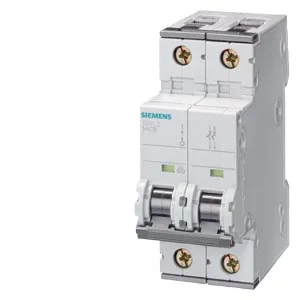
The D-curve means it tolerates inrush currents up to 10–20× rated — designed for motor, transformer, and welding loads that pull a heavy start-up spike without nuisance tripping. The magnetic-only design (no thermal bimetal) makes it strictly a short-circuit protector; it does not provide overload protection, so upstream or downstream overload coordination must be handled separately. Rated breaking capacity is 25 kA per IEC 60947-2, with a secondary 5 kA rating per UL 1077 and CSA C22.2 No.235 for North American panels. Rated voltage is 440 V AC single- or multi-phase.
The 12.5 A D-curve is the headline spec. D-curve breakers are common in European industrial panels for motor branch circuits, small transformers, and capacitor banks where the magnetizing inrush would trip a B or C curve. The magnetic-only mechanism (no thermal element) eliminates nuisance tripping from ambient heat in a warm cabinet — but also means you cannot rely on this breaker for overload protection; that must be handled by a separate overload relay or motor-protective breaker upstream. Vibration resistance per IEC 60068-2-6: ±1 mm at 5–25 Hz, 50 m/s² at 25–150 Hz, so it holds up on machine-mounted panels near rotating equipment.
Integration into a panel — what to check
Snap-on DIN rail mount, any position. The quick assembly system means it clips onto the rail and the comb busbar slots into the combined terminals top and bottom — no separate busbar bridge needed. Width is 2 modular units (36 mm), so it takes two 18 mm slots on the rail. Installation depth 70 mm leaves clearance inside a standard 100 mm deep enclosure. Touch protection is built into the terminals. Operating temperature range is -40 °C to +75 °C, with humidity derating: max 95% at 55 °C, down to 35% at 75 °C.