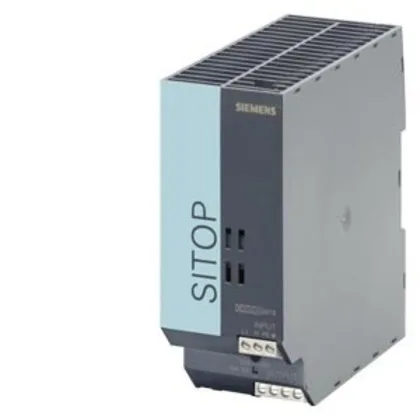
The Siemens 6EP1333-3BA10 is a SITOP PSU100M series power supply delivering a rated 5 A at SELV output, with galvanic isolation per EN 60950-1 and EN 50178. It accepts a wide AC input range — 85 to 264 V single-phase, or 176 to 550 V two-phase — making it viable for both standard 120/240 V shop-floor panels and 400/480 V industrial feeds without a separate step-down transformer. Efficiency hits 88% at nominal load, so it runs cool enough for a crowded DIN rail enclosure. It snaps onto standard DIN rail EN 60715 35x7.5/15, occupying a 50 mm top-to-bottom footprint with zero overhang left or right. That 50 mm depth is the panel-builder's constraint — the gland plate and door clearance need to accommodate it.
The 5 A rated output is continuous over the full 0 to 5 A range, not a peak figure. That's the number to size your DC load bus — sensors, PLCs, relays, and small actuators — not a surge rating. The I²t maximum of 1.7 A²·s tells you what the internal fuse (T 3.15 A, non-accessible) can handle for short overloads before opening. Leakage current is spec'd at a typical 0.25 mA, maximum 3.5 mA. For a wind-turbine nacelle or offshore installation where ground-fault detection thresholds are tight, that typical figure keeps you below most nuisance-trip levels. No ATEX or IECEx certification, so it's not rated for explosive atmospheres — keep it in the control cabinet, not the hazardous zone. Operating temperature spans -25 to +70 °C with natural convection, and startup is tested from -40 °C at nominal voltage. Storage and transport range is -40 to +85 °C. That -40 °C startup matters for turbines parked in a Nordic winter — the supply fires up before the nacelle heater has warmed the cabinet.
Feeder Protection and Wiring
Siemens specifies the upstream protection clearly: for single-phase operation, a miniature circuit breaker from 6 A (10 A) with characteristic C (or B). For two-phase operation at 230 V, use a 2-pole breaker or the specific 3RV2011-1EA10 (set to 3.8 A) or 3RV2711-1ED10 (UL 489). At 400/500 V two-phase, switch to 3RV2011-1DA10 (set to 3 A) or 3RV2711-1DD10. These are not suggestions — they guarantee coordination so the feeder trips before the internal fuse opens. Input terminals accept 0.2 to 2.5 mm² single-core or finely stranded wire, one screw terminal each for L, N, and PE. Output side gives two screw terminals each for + and -, same wire range. Spring-cage would be faster to land, but screw terminals hold better under vibration — a plus for the nacelle environment.