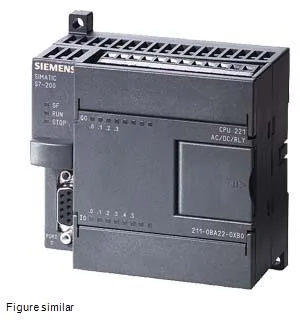
Power supply and I/O — what the 24 V rail means
The 6ES7211-0BA23-0XB0: That 20 % tolerance covers most industrial DC buses, but if your panel has a heavily loaded 24 V rail that sags below 20.4 V under motor inrush, the CPU browns out — the backup capacitor holds the program for 50 h (min. 8 h at 40 °C) with an optional battery module extending that to 200 days typ.. Six digital inputs, four transistor outputs — all outputs switch in 10 ms max. The source/sink input configuration is selectable per group, which matters when you mix NPN and PNP sensors on the same block without external pull resistors.
Communication — MPI and PPI on the RS-485 port
The integrated RS-485 interface supports both MPI and PPI protocols. MPI runs at 19.2/187.5 kbit/s and lets the CPU 221 act as an MPI slave to S7-300/S7-400 CPUs, OPs, and TDs. PPI covers program upload/download and HMI communication with TD 200 and OP panels at 9.6/19.2/187.5 kbit/s. Shielded cable max 500 m, unshielded 150 m.
High-speed counters and interrupt-driven logic
Four 32-bit high-speed counters, each 30 kHz, can be configured as up/down counters or as A/B quadrature encoders at 20 kHz. The parameterizable enable, reset, and interrupt-on-setpoint call a subroutine immediately — no scan-cycle jitter. This is the edge that matters for packaging registration or conveyor position capture without a dedicated counter module.
Programming and memory — EEPROM, no battery required
The CPU 221 stores the entire program on integral EEPROM — no battery needed for program retention. DB 1 current values live in RAM, backed by a high-performance capacitor (50 h min.) or an optional battery (200 days typ.). Programming in LAD, FBD, or STL; the instruction set covers bit logic, timers (1 ms to 54 min), counters, integer and floating-point math, shift/rotate, and program control.