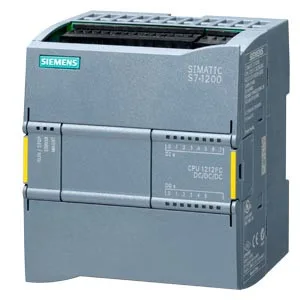
The Siemens 6ES7214-1HF40-0XB0 is a compact CPU with integrated failsafe logic, so the same backplane that runs standard I/O also hosts safety logic up to PROFIsafe over PROFINET. Onboard programming language set covers FBD (incl. failsafe), LAD (incl. failsafe) and SCL, with the standard DCP and F-programming used together so safety and standard code live on one controller. Note one column the integrator will check first: IRT is not listed for this CPU, so PROFINET real-time classes that depend on isochronous IRT cannot be planned against this part — the panel-side PROFINET design is non-isochronous unless a CP is added. Connection budget is the next constraint: 34 connections reserved out of 64 max, with HMI at 12 reserved / 18 max, S7 at 8 / 14 max, Web at 2 / 30 max and OPC UA at 0 reserved / 10 max — easy to undersize if HMIs are added late.
Fieldbus and comms slice
Ethernets side brings TCP/IP, Modbus TCP, OPC UA Server, SNMP, LLDP and the integrated web server in the box, so plant-level dashboards and IT/OT polling tools reach the CPU directly. PROFINET is on board for the safety communication path; PROFIBUS is not — the datasheet lists it as requiring the CM 1243-5 (master) or CM 1242-5 (slave) communications module if a PROFIBUS segment must remain on this CPU. Forcing is permitted on peripheral inputs/outputs without fail-safe, which speeds commissioning; the ERROR and MAINT LEDs on the front face are the first thing the FAT/SAT engineer checks before any online session.
Panel-side envelope
Footprint is 110 mm wide × 100 mm high × 75 mm deep on DIN rail, leaving space for signal modules and a CM to its right. Supply is 24 V DC with the documented minimum at L+ minus 4 V DC — that floor matters when the panel runs long 24 V trunks and the end-of-line drops below the CPU's dropout threshold under inrush. Integrated load memory is 4 Mbyte, with bit-memory address area sized to 8 kbyte; program sizing for a small machine fits comfortably, a multi-cell line typically exceeds it.
Analog on board and approvals on the nameplate
The 0 to +10 V analog input is present and adjustable, useful for a single speed reference or trim pot without burning a SM module; CE mark and cULus are on the nameplate for US/EU cabinet builds. DHCP is not supported — the IP plan must be static or handled at the router/scanner, not handed out by a DHCP server to the CPU.
Where the 1214F sits against a 1214 and a 1212
Against the 6ES7214-1HG40-0XB0, also in the 1214F family, the swap question comes down to I/O count and relay/transistor output mix on the HG40 — confirm the on-board I/O and the output type (relay vs transistor/DC) match before treating it as a drop-in, because a mismatch there forces a wiring rework even if the F-class capability is identical.