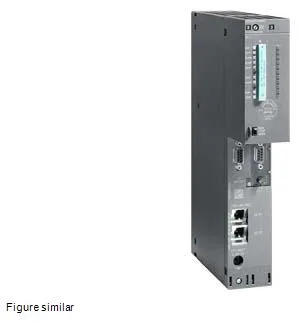
CPU 416-3 for S7-400 — what this order code delivers
The Siemens 6ES7416-3FS06-0AB0 is a CPU 416-3 for the S7-400 rack, supporting IRT (isochronous real-time) PROFINET communication alongside PROFIBUS DPV0. It carries 244 bytes each of process-image inputs and outputs, and its FM (function module) count is limited by the number of slots or connections in the central controller — a hard constraint when planning a dense rack. Programming options cover CFC, FBD, LAD, SCL, STL, and GRAPH — all six IEC 61131-3 languages plus the continuous function chart. That means the same CPU can serve a team mixing ladder-maintenance engineers and structured-text developers without a software compatibility fight. No MPI interface is present on this CPU; communication relies on the integrated PROFINET interface (TCP/IP and UDP via loadable FBs) and the RS 485 port for PROFIBUS. If your existing S7-400 network uses MPI as the primary bus, this CPU forces a migration to PROFINET or DP.
Rack planning constraints
The CPU occupies a single-wide slot at 50 mm width, 290 mm height, and 219 mm depth — standard S7-400 form factor. It fits any UR1/UR2 rack without modifying the backplane. Communication processor (CP) count is capped at four in the central controller, and mixed operation of CP443-1 EX40 with EX41/EX20/GX20 is not allowed. For PtP modules, CP 440 and CP 441 are limited by both slot count and connection count — plan the CP layout before locking the rack configuration. Electrical isolation is provided between interfaces, which simplifies grounding in mixed-voltage panels where PROFIBUS and PROFINET share a rack with 24 VDC I/O.
Communication and data record handling
PROFIBUS DPV0 is supported; DPV1 is not. That means acyclic data exchange (alarm handling, parameter write during operation) is unavailable on the DP bus — use PROFINET for those services. The CPU provides eight RDREC, WRREC, and blocks each, plus eight RDSYSST and blocks for system status and DP diagnostics. Routing is supported with the interface active, enabling the CPU to forward PROFINET traffic to PROFIBUS segments and vice versa — useful when a programming device on the plant network needs to reach a DP slave behind the CPU. A GSD file is available for PROFIBUS master configuration, and forcing is supported for commissioning and troubleshooting.