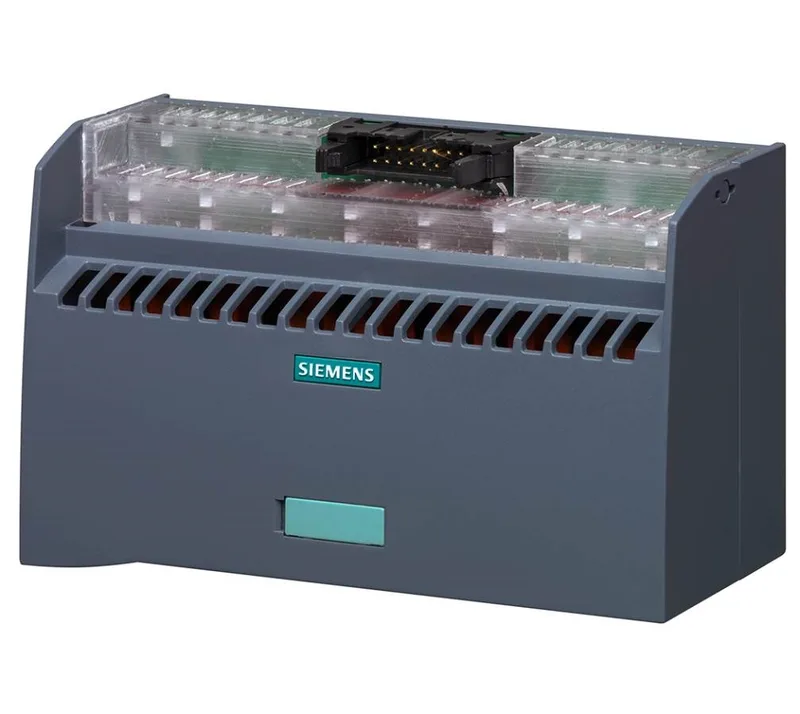
The Siemens 6ES7924-0BE20-0BC0 is a connection module designed for SIMATIC S7-300 and S7-1500 systems, specifically to relay digital input signals from the front connector to the I/O module. It mounts on either 35 mm or 15 mm DIN rail, with any orientation allowed, making it flexible for tight panel layouts. Rated at 50 V and 1 A, it handles the signal-level currents typical of digital inputs. The 20 terminals are arranged as 8 input pairs (I x 2) plus 2 each for L+ and M, giving you a clean, dedicated path for field wiring back to the module. The push-in connection type accepts stranded wire from 0.2 to 2.5 mm², and a 3.5 mm screwdriver blade is specified for release. No shield connection or PE connection is provided on this module — those are handled upstream at the I/O module or cabinet ground bar.
The 50 V rated value and 1 A current are the maximums for the module's internal bus; they do not limit the field-side sensor voltage. The module is a passive interconnection — it passes through the signal from the front connector to the I/O card, so the actual voltage and current on the field wires are determined by the connected sensor and the I/O module's specifications.
Installation notes from the field
Maximum cable length between the front connector module and this connection module is 30 m. For runs approaching that limit, use twisted-pair cable to maintain signal integrity. The module does not require an end cover plate, and it supports an infeed function for daisy-chaining supply voltage to additional modules. Each terminal can accept up to two wires in a ferrule, as long as the combined cross-section stays within the 2.5 mm² limit. The single-contact NO relay design per channel means no mechanical latching — signal state follows the input directly.