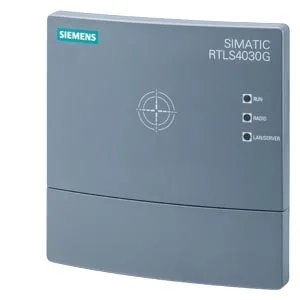
The Siemens SIMATIC RTLS4330A anchor (order code 6GT2701-5EA03) is a fixed-position node in a real-time locating system, using UWB and Chirp spread-spectrum radio to track assets or personnel within a defined area. It communicates over a MESH network using IEEE 802.15.4-2011 UWB and IEEE 802.15.4a CSS protocols, operating in the 3100–7000 MHz and 2400–2480 MHz bands. The anchor is designed for use with the RTLS4300 system, providing location data with a typical accuracy of 0.2 m on the UWB band and 1.5 m on the Chirp band. Maximum open-air range is 30 m for UWB and 1000 m for Chirp, though actual performance depends on installation conditions and the manual should be followed.
The housing is ASA+PC plastic in Ti gray, and the unit is silicon-free, which matters for paint-shop or potting applications where silicone contamination is a concern. Supply voltage is 10–30 VDC, with a rated value of 24 VDC, and the maximum current draw is 0.3 A. That means a standard 24 VDC industrial power supply can run multiple anchors on one branch, but the total load on the supply must account for the 0.3 A per unit. The single digital output (sinking, at the same connector) can drive a small indicator or relay for local status. The anchor mounts with three M4 screws and measures 180 mm wide by 180 mm deep by 48 mm high — a compact, square footprint that fits on walls, columns, or ceiling grids. The included corner mount bracket and ceiling suspension plate give flexibility for positioning in a production cell or warehouse aisle.
This class of part — a UWB/Chirp anchor — is deployed in indoor industrial environments for real-time location of assets (tools, AGVs, work-in-progress) or personnel (safety zone monitoring, workflow tracking). The 0.2 m UWB accuracy is tight enough to distinguish which workstation a cart is at, while the Chirp band's longer range (1000 m) can cover a large warehouse with fewer anchors, albeit at lower precision.