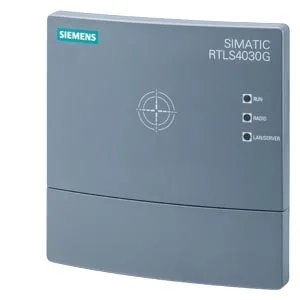
What this anchor does on your line
The Siemens 6GT2701-5EB03 is an RTLS4300-series UWB anchor purpose-built for real-time locating systems using Chirp spread-spectrum technology. It reports tag positions with a typical accuracy of 0.1 m in the UWB band (3100–7000 MHz) and 1.5 m in the 2.4 GHz band, following IEEE 802.15.4-2011 UWB. That sub-decimeter precision means it can resolve which zone a pallet or AGV occupies on a packaging line — enough to trigger a merge or divert decision without mechanical sensors. Communication runs over TCP/IP via a standard RJ45 with PoE per IEEE 802.3af, so a single cable carries both data and 24 V DC power. The anchor draws 0.38 A at 24 V maximum. A secondary Bulgin PX0412/03P 3-pin connector handles the digital output — one output, no inputs — which can drive a local indicator or relay without pulling back to the controller. The IP65-rated ASA+PC housing (Ti gray, 180 × 180 × 48 mm) mounts with three M4 screws. Included corner brackets and a ceiling-suspension plate give flexibility for overhead or wall placement in washdown areas. Operating and storage temperature range is -15 to +50 °C.
Protocol and network fit
The anchor speaks TCP/IP but does not support DCP, LLDP, SNMP (v1/v2/v3), OPC UA, EtherNet/IP, or PROFINET IO. That makes it a straightforward IP device on a standard Ethernet switch — no industrial-protocol stack to configure, but also no DCP-based device discovery or PROFINET diagnostic integration. Plan for a static IP or DHCP assignment via the network infrastructure.
Mounting and environmental constraints
Three M4 screws through the housing base. The 180 × 180 mm footprint and 48 mm height fit under a typical machine canopy or on a ceiling grid. The IP65 seal handles washdown on packaging lines — the ASA+PC shell resists food-grade cleaning agents, and the silicon-free construction avoids contamination in paint or coating environments. Range in open air is stated at 30 m for the UWB band and 1000 m for the 2.4 GHz band, but the manual's note to 'always follow the manual' means real-world range depends on antenna placement, building materials, and tag density.