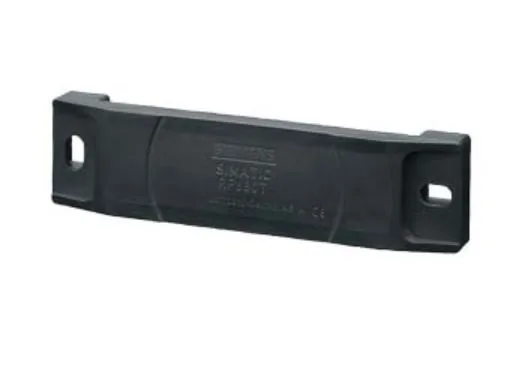
The Siemens 6GT2810-2AE81-0AX1 is a SIMATIC RF630L SmartLabel PET — a passive UHF RFID tag built for the RF600 reader family. It operates across the full 860 to 960 MHz band, covering global UHF allocations (Europe, US, Japan). The tag uses an NXP G2iL chip with 128-bit EPC memory (expandable from 96-bit), 64-bit TID, and 16 bytes of user memory. Protocol compliance is EPCglobal Class 1 Gen 2 / ISO 18000-63, so it interoperates with standard UHF readers, not just Siemens hardware.
The IP67 rating applies only when the tag is properly adhered — the adhesive creates the seal. That means it survives washdown on a food line or outdoor exposure, but a loose tag sitting in a bin is not IP67. The operating temperature during read/write is -25 to +85 °C; outside the read/write area the tag can survive -40 to +160 °C for up to 90 minutes, which covers paint-oven or autoclave cycles. The maximum read range is 4 m, but that is reader-dependent and overrange is possible — the system manual (RF600) should be consulted for actual application limits.
Physical construction and mounting
The tag measures 90 x 30 mm with a thickness of 0.3 mm — essentially a durable label. The material is PET with one-side adhesive fastening. The core diameter is 76 mm and it ships 3500 units per roll, with a minimum order quantity of 7000 units. Torsion and bending stress are conditionally permissible, so it is not designed for flexing around tight radii repeatedly. The adhesive is specified as strongly adhesive on plastic; surface energy of the mounting substrate matters for long-term bond.
Memory and data features
The EEPROM-based memory supports lock, unlock, kill, write protection, and password protection — standard Gen2 security commands. The tag is multitag-capable, meaning multiple tags can be read in the field simultaneously. The maximum transfer rate is 320 kbit/s, which is typical for passive UHF Gen2. There is no backup battery; this is a purely passive tag powered by the reader field.