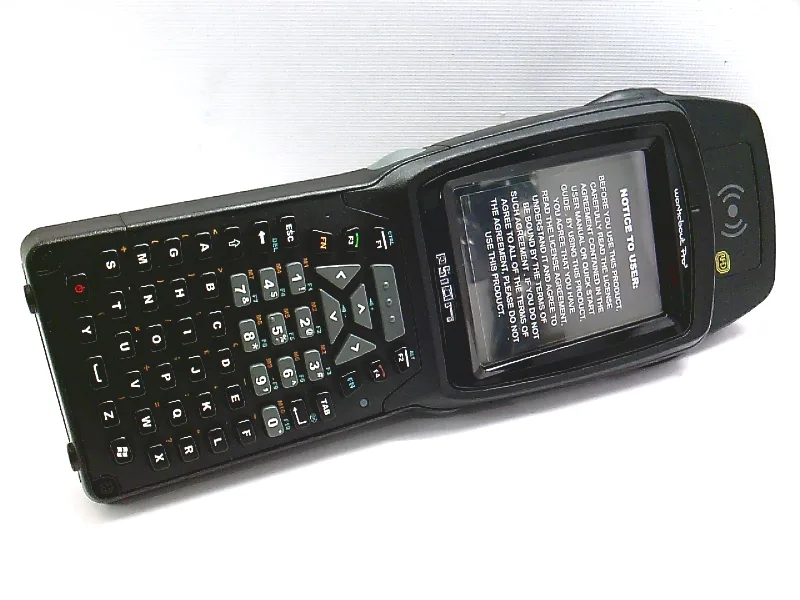
The Siemens 6GT2813-0CA10 is the SIMATIC RF650M FCC — a mobile UHF RFID reader from the RF600 family, built for reading ISO 18000-6C / EPCglobal Class 1 Gen 2 transponders at 902 to 928 MHz with an equivalent isotropically radiated power of 820 mW. It ships as a complete kit: the reader, a replaceable Li-Polymer accumulator (2260 mAh / 3.7 V), and a charging/docking station with USB and Ethernet interfaces plus a 100-240 V charging device. The 2.2-inch QVGA color touch screen (240 x 320 pixels) and alphanumeric operator elements let you interact with the device directly, while the pre-installed Windows Embedded CE 6.0 operating system runs the application logic.
The 2500 mm read range means this reader can interrogate tags from a comfortable distance — useful for scanning pallet labels or work-in-progress totes without precise positioning. The MTBF of 43 years is a reliability projection for the electronics under continuous operation — a strong figure that supports holding this as a critical spare rather than running it to failure. Typical battery life of 9 hours on a full charge covers a full shift of mobile scanning, and the hot-swappable Li-Polymer accumulator means you can keep working by swapping packs. Multitag-capable and running the full ISO 18000-6C protocol stack, it handles bulk reads of multiple tags in the field simultaneously — not just single-tag interrogation. Operating temperature from -20 to +55 °C and a 1.5 m drop height rating make it field-hardy for industrial floors, cold storage, or loading docks.
For a BOM-critical spare or a new deployment, the prudent move is to quote this against an RFQ to confirm availability and lead time before committing the line.
Integration notes
Communication with a host system goes through WLAN (802.11a/b/g/n), USB, or Ethernet via the charging station — no fixed fieldbus port on the reader itself. The reader handles linear horizontal, vertical, and automatic polarization, so tag orientation is less of a concern during mobile scanning. Application development uses the MS Visual Studio 2008 API, available in several programming languages, which means integrators with a.NET background can build custom scanning logic. Data and program memory totals 288 Mibyte, with 256 Mibyte of RAM and 256 Mibyte of usable data memory — enough for tag databases and local buffering.