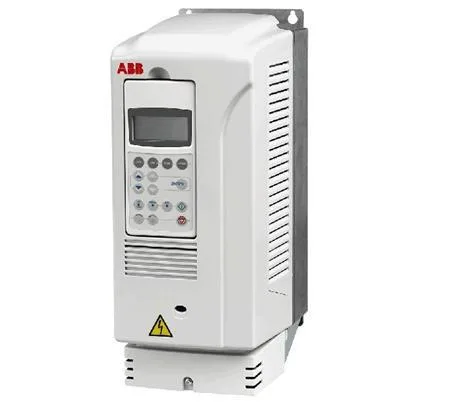
What the order code carries
The ABB ACS800-U1-0004-5+L503+P901 is a wall-mount industrial AC drive from the legacy ACS800-U1 family, and the string past the base part number is option code — +L503 and +P901 are ABB factory-fitted modifications that the order line breaks out separately so the panel builder can read the BOM and the commissioning engineer can match the nameplate exactly to what was specified. It lives in the Drives / Motor Drives branch under Motors & Motor Controls, the slot a single-motor wall-mount AC drive like this one is normally specified into.
On the bench and in the panel
Unit mass is 7.53 kgs, which is a one-person lift for an installer working off a step ladder but worth cabling in before final wall fix — the back-plate lugs are sized for a static load only, not a swinging one, so the field service tech should hang the drive, torque the mounting bolts, then land the power and control conductors. Because the +L503 and +P901 suffixes are pre-engineered into the build, the option cards and terminal assignments ship already mapped — power it up and prove it against the nameplate macros, then walk through the application macro that matches the driven load before any auto-tune pass.
Reading the ACS880 successor against this frame
The ACS880-01 successor family is the natural second-source question, but the swap is a platform change, not a form-fit replacement. The ACS880-01-07A6-5 weighs 6.35 kgs, the ACS880-01-021A-5 weighs 7.71 kgs, and the ACS880-01-052A-5 weighs 9.07 kgs — each within roughly a kilogram of this drive, but the panel cutout, control terminals, and firmware macros are ACS880-native.
Sourcing posture for a legacy line
For an MRO planner holding a spare for a line that is still running on ACS800-U1 hardware, that posture is the working answer: keep the full option string on the BOM, source through an RFQ, and verify the nameplate suffix by suffix when the unit lands before the commissioning engineer starts the auto-tune.