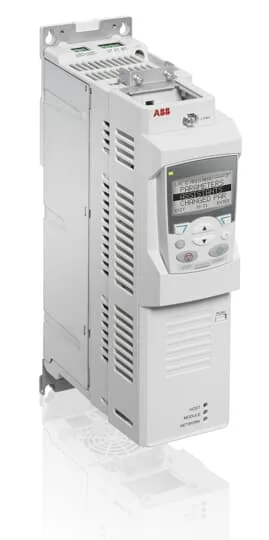
What you've got on the bench
The ACS850-04-018A-5+J400: Listed weight is 4.99 kg, which puts it well inside the bracket-mounted handling range — a single tech can hang it on the wall plate without a second pair of hands or a panel cutout, but the chassis still wants a solid mechanical anchor given the cooling airflow pattern of the ACS850-04 series. Drive-class sourcing buys on the suffix, not just the frame. The +J400 tail on an ACS850-04-018A-5 changes the option set the unit ships with, so any BOM line carried under this exact string has to match that tail — a bare ACS850-04-018A-5 is not the same ship-as configuration.
Cross-shop against the ACS880-01-11A0-5
On mass alone, the ACS880-01-11A0-5 sits at 4.54 kg versus the ACS850-04-018A-5+J400 at 4.99 kg — close enough that handling doesn't change the call, but the panel-side bracket and gland layout still drive the real fit decision, not the kilogram delta.
Where this drive typically lands
ACS850-04-frame drives of this current class are typically deployed as stand-alone cabinet wall-mount units driving a single induction or permanent-magnet motor on a process line — pump, fan, conveyor, or extruder — with the +J400 suffix covering a defined option package on top of the base drive. The commissioning checklist for this class starts with the line-ground bond at the gland plate and a shielded motor cable run straight to the motor junction box, because the only EMC story that holds is the one that doesn't daisy-chain the PE across the cabinet. For a swap-out on a line-down call, the practical sequence is: confirm the order code string on the nameplate against the BOM line, verify the +J400 option set matches what the cabinet was wired for, then power up and walk the parameter tree — motor ID, ramp profile, and fieldbus node — before re-coupling to the load. Skipping the nameplate match is the most common way a 'same drive' spare turns into a half-day of fault chasing.