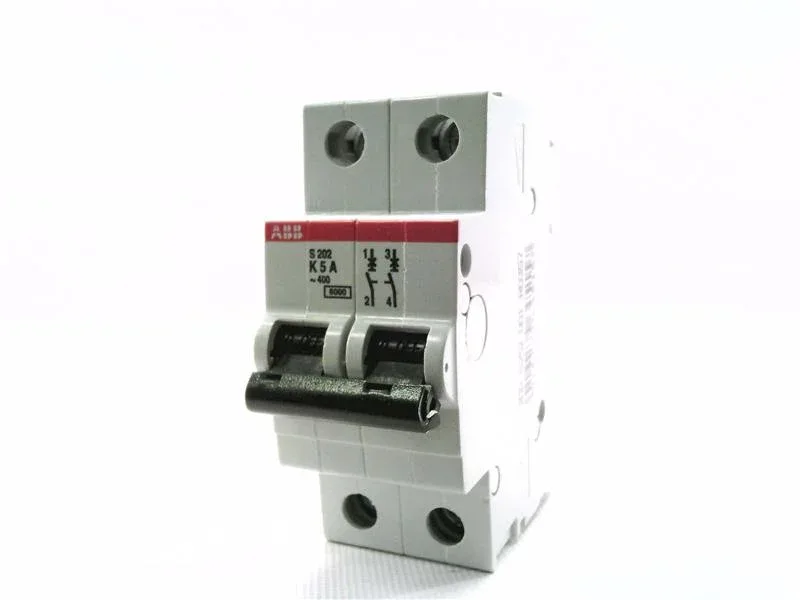
What this 5 A K-curve breaker does in the panel
The ABB S202-K5 is a 2-pole supplemental protector from the S200 series, rated 5 A at 277 VAC with a K-curve trip characteristic and 6 kA interrupting capacity.
K-curve vs. other trip curves — the real difference
The K-curve is the deciding factor here. Compared to a C-curve breaker of the same frame (e.g., S202M-C10), the K-curve has a wider magnetic-trip band — typically 8–12× rated current vs. 5–10× for C-curve. That extra headroom means the S202-K5 holds through the higher inrush of a motor start or a transformer energization where a C-curve might trip. The trade-off: the K-curve is not a motor-circuit protector (MCP) — it is a supplemental protector per UL 1077, not a branch-circuit rated device. Use it for component-level protection inside a control panel, not as the sole overcurrent device feeding a motor from a distribution panel.
The 2-pole footprint occupies two module widths (36 mm). Rated 277 VAC line-to-neutral or 480Y/277 VAC three-phase. Interrupting capacity is 6 kA at 277 VAC, which is adequate for most control-panel fault-current levels below that threshold. Listed to UL 1077 and CSA 22.2 — these are the standards that define it as a supplemental protector for use within an enclosure, not a branch-circuit main breaker. That distinction matters for the panel's SCCR calculation: the S202-K5 can be used as a component in a listed assembly, but the overall short-circuit current rating of the panel must be verified per UL 508A.