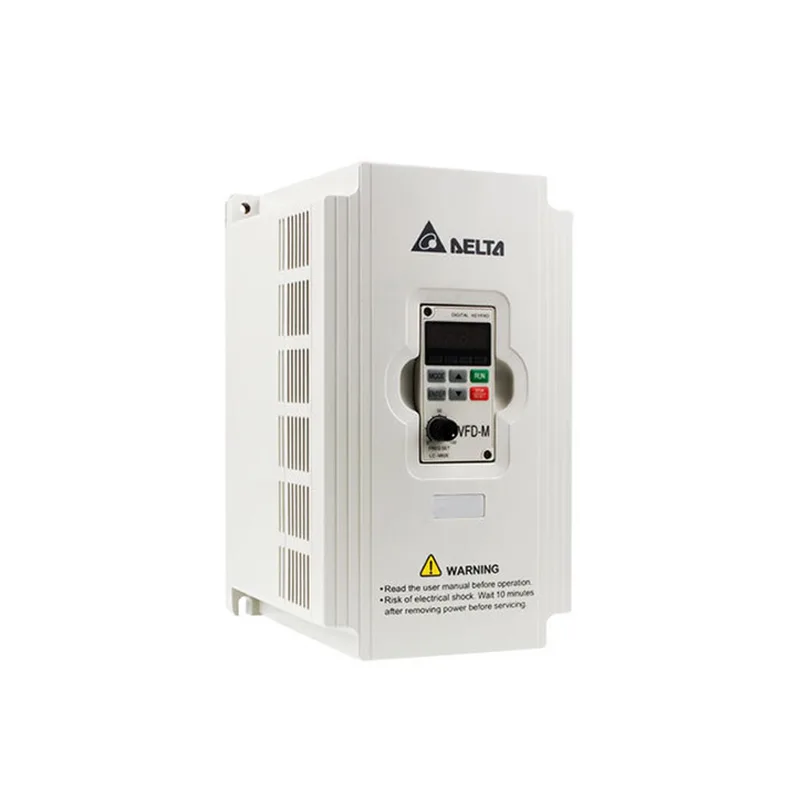
Drive class and what it does
Variable-frequency drive (VFD): a solid-state power converter that rectifies an AC mains supply into a DC link and re-inverts it to a variable-voltage, variable-frequency output, letting a standard induction motor run across a controlled speed range rather than at fixed line frequency. Delta's VFD-M series — to which the VFD022M23A belongs — is the general-purpose sensorless vector control micro-drive line, typically specified for fans, pumps, conveyors and small machine tools where compact panel footprint and basic closed-loop torque performance are wanted without stepping up to a higher-tier drive.
Input ratings and mains tolerance
Input is rated 200-240 VAC single- or three-phase at 50/60 Hz, with ±10% voltage tolerance (180-264 VAC) and ±5% frequency tolerance (47-63 Hz), so the drive rides through the usual generator and lightly loaded transformer excursions without tripping on its own supply monitor. The '23' in VFD022M23A marks the three-phase 230 V input variant; rated input current is 27 A on single-phase feed or 12.5 A on three-phase, with the three-phase figure of 12.5 A also applying when a single-phase model is wired across three-phase power.
Output ratings and motor sizing
Output is 3-phase, proportional to input voltage, at 10 A continuous rated current and 3.87 kVA rated output capacity, sized to a maximum applicable motor of 2.2 kW (3 HP) — so the drive's thermal ceiling is the current rating, not the kW label, and any motor pulled above 10 A on its nameplate will sit outside the drive's continuous envelope. Output frequency covers 0.1-400 Hz and the carrier is adjustable 1-15 kHz, so low-speed holding torque is available down to fractional Hz for slow conveyor indexing, while pushing carrier above the default 8 kHz region will trade acoustic noise for additional switching loss and require derating at the higher kHz settings.