| Input signal current x010 or later | 5 mA / 24 VDC |
|---|
| Input ON sensitivity current x000 to x007 | 4.5 mA or more |
|---|
| Input ON sensitivity current x010 or later | 3.5 mA or more |
|---|
| Power consumption | In the case of the maximum configuration that can be connected to the 20 W basic unit, it is the value when using 24 VDC service power. It also includes input current (7 mA or 5 mA per point). |
|---|
| Power supply fuse | 250V 1A |
|---|
| External power supply | DC 5 to 30 V |
|---|
| 24 VDC service power supply | 400 mA |
|---|
| Allowable momentary power outage time | Operation continues with an instantaneous blackout of 10 ms or less. |
|---|
| Rated frequency | 50/60 Hz |
|---|
| Maximum frequency | 100 kHz |
|---|
| Anti-vibration direct installation frequency | 57 to 150 Hz : Acceleration: 9.8 m / s 2 X, Y, Z 10 times in each direction (80 minutes in total) The criteria are based on IEC 61131-2 |
|---|
| Anti-vibration when DIN rail is installed frequency | 57 to 150 Hz : Acceleration: 4.9 m / s 2 Ten times in each of X, Y, Z directions (total of 80 minutes each) The criterion is based on IEC 61131-2 |
|---|
| 1 phase 1 count input | [C235, C236] 60 kHz [C237 to C240] 10 kHz [C241] 60 kHz [C242 to C245] 10 kHz When using multiple high-speed counters, make sure that the total of operating frequencies is less than the total frequency. |
|---|
| 1 phase 2 count input | [C246] 60 kHz [C248 (OP)] 10 kHz [C247 to C250] 10 kHz When using multiple high-speed counters, make sure that the total of operating frequencies is less than total frequency. |
|---|
| 2 phase 2 count input | [C251] 30 kHz [C253 (OP), C252 to C255] 5 kHz When using multiple high-speed counters, ensure that the total operating frequency is less than the total frequency. |
|---|
| Input connection shape | Fixed terminal block (M3 screw) |
|---|
| Output connection shape | Fixed terminal block (M3 screw) |
|---|
| Input response time | Approximately 10 ms X000 to X017 have a built-in digital filter and can be changed in 1 ms increments to 0 to 15 ms according to application instructions and D8020. However, when set to 0, it becomes the following. X000, X001: 10 .mu.s X002 to X007: 50 .mu.s X010 to X017: 200 .mu.s |
|---|
| Response time (OFF ? ON) | Y000, Y001: 5 µs or less / 10 mA or more (DC 5 to 24 V) Y002 to Y015: 0.2 ms or less / 200 mA or more (DC 24 V) |
|---|
| Response time (ON ? OFF) | Y000, Y001: 5 µs or less / 10 mA or more (DC 5 to 24 V) Y002 to Y015: 0.2 ms or less / 200 mA or more (DC 24 V) |
|---|
| Operating temperature | 0 to 55 ° C. ··· Operating, -25 to 75 ° C. ····· Save |
|---|
| Use altitude | It can not be used under an environment pressurized to 2,000 m or less under atmospheric pressure. It may break down. |
|---|
| Relative humidity | 5 to 95% RH (noncondensing) · · · · in operation |
|---|
| Shipping weight | 1.3 Kg |
|---|
| Mass (weight) | 0.30 (0.66) |
|---|
| W | mm (inches) : 75 (2.96”) |
|---|
| W1 | mm (inches)Direct mounting hole pitches : 67 (2.64”) |
|---|
| Ground | Class D grounding (grounding resistance: 100 O or less) Grounding should be dedicated ground or common ground. |
|---|
| Input format | Sink / source |
|---|
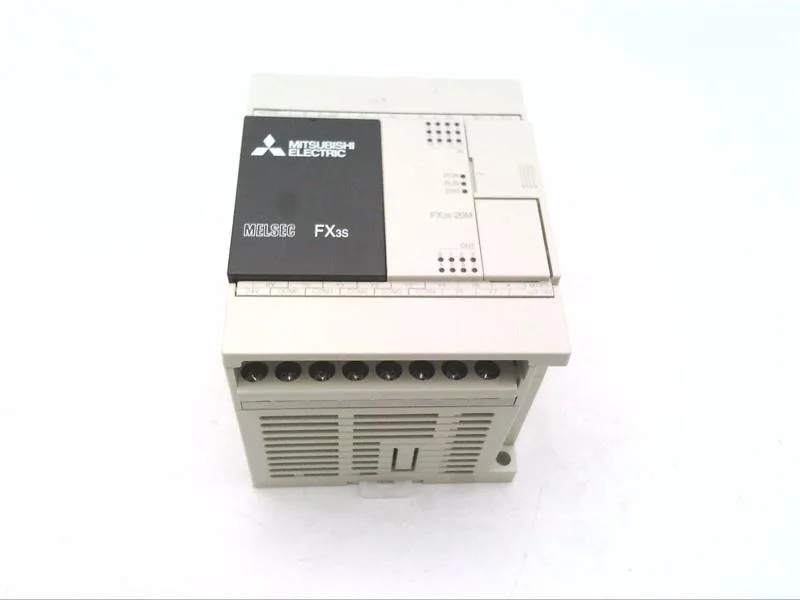
| Manufacturer | Mitsubishi Electric |
|---|
| Device nesting | [For master control] N 0 to N 7 8 points (for MC command) |
|---|
| Noise immunity | Noise voltage with 1,000 Vp-p, noise width 1 µs, rising 1 ns, with noise si |
|---|
| Use atmosphere | There is no corrosive property, flammable gas, conductive dust (dust) is not serious |
|---|
| Impact resistance | 147 m / s 2 , working time 11 ms, criterion for judgment three times in X, Y, Z directions by sine half-wave pulse is according to IEC 61131-2 |
|---|
| Circuit insulation | Photocoupler insulation |
|---|
| Estimated lead time | Usually ships in 1 - 10 working days. |
|---|
| Input signal format | No-voltage contact input At sink input: NPN open collector transistor Source input: PNP open collector transistor |
|---|
| Positioning command | · ABS current reading ([D] ABS) · Origin with DOG search [DSZR] · Origin return [ZRN] (No DOG search function) Decelerates with near point DOG: ON and stops at near point DOG: OFF . (It differs from zero point return operation by counting the zero point signal) · Variable speed pulse output [PLSV] · Relative positioning [DRVI] · Absolute positioning [DRVA] Pulse output format: Pulse train + direction |
|---|
| Programming language | Sequence program |
|---|
| Insulation resistance | When conducting the insulation resistance test, perform the following voltage between each terminal and the ground terminal of the basic unit. Between the power supply terminal (AC power supply) and the earth terminal: 500 VDC DC insulation resistance meter 5 MO or more DC 24 V service power supply, between the input terminal (24 VDC) and the earth terminal: 500 V DC 500 MO or more with the insulation resistance meter Output terminal Between: 500 MV DC Insulation resistance meter 5 MO or more |
|---|
| Number of control axes | Independent 2 axes |
|---|
| Number of input points | 12 points |
|---|
| Device for general use | S128 to S255 128 points |
|---|
| Input operation display | LED on the panel when driving the photo coupler |
|---|
| Number of output points | 8 points |
|---|
| Corresponding basic unit | Transistor output type basic unit |
|---|
| Input circuit insulation | Photocoupler insulation |
|---|
| Pulse output instruction | · Pulse output (PLSY) · Pulse output with acceleration / deceleration (PLSR) Pulse output format: Pulse train (direction controlled by sequence) |
|---|
| Constant hexadecimal | 16 bits: 0 to FFFF 32 bits: 0 to FFFFFFFF |
|---|
| Constant real number | 32 bits: -1.0 × 2 128 to -1.0 × 2 - 126 , 0, 1.0 × 2 - 126 to 1.0 × 2 128 Decimal point representation and exponential representation are possible |
|---|
| Arithmetic control method | Stored program iterative calculation method with interrupt instruction |
|---|
| Device high speed counter | [32 bit high-speed up / down (EEPROM keep)] Up to 6 points can be used in C235 to C255 1 phase: 60 kHz, 10 kHz 2 phases: 30 kHz, 5 kHz There are restrictions on points and input frequencies that can be used depending on the conditions used. ? Note on Keep Area Keep area and non-keep area are fixed. (Parameter can not be changed.) In order to reliably keep to EEPROM, it is necessary for the sequencer to be energized for at least 5 consecutive minutes. |
|---|
| Maximum load inductive load | The total load per 12 W / DC 24 V common should be as follows. Output 1 point / common: 12 W or less / 24 VDC output 4 points / common: 19.2 W or less / 24 VDC |
|---|
| Maximum load resistive load | The total load current per 0.5 A / point common should be as follows. Output 1 point / common: 0.5 A or less Output 4 points / common: 0.8 A or less |
|---|
| Output operation indication | LED on the panel surface when photo coupler is driven |
|---|
| Constant decimal number | 16 bits: -32,768 to + 32,767 32 bits: -2, 147, 483, 648 to +2, 147, 483, 647 |
|---|
| Input impedance x000 to x007 | 3.3 kO |
|---|
| Device timer (on-delay) 1 | T63 to T127 65 points (0.001 to 32.767 seconds) |
|---|
| Input (output control method) | Batch processing method (when END instruction is executed), I / O refresh command, with pulse catch function |
|---|
| Input impedance x010 or later | 4.3 kO |
|---|
| Device timer (on-delay) other | Two internal analog volume can be used as analog timer VR 1: D 8030, VR 2: D 8031 ??2 points (0 to 255) |
|---|
| Real time clock clock function | Built-in 1980 to 2079 (with leap year correction) 2-digit / 4-digit year AD changeable, monthly difference ± 45 seconds (25 ° C) ? Note on clock function The current time of the built- It is backed up with. The large capacity condenser (built-in) is fully charged at the energization time of 30 minutes and holds the present value for 10 days. |
|---|
| Device i (O relay input relay) | X000 to X017 16 points (octal number) can not be added (FX 3 S - 20 M ? corresponds to the range from X 000 to X 013) |
|---|
| Device pointer input interrupt | I 0 ? ? - I 5 ? ? 6 points |
|---|
| Device pointer timer interrupt | I6 ?? - I 8 ? ? 3 points |
|---|
| Device timer (on-delay) 100 | T 0 to T 31 63 points (0.1 to 3,276.7 seconds) |
|---|
| Device counter 32 bit up / down | C200 to C234 35 points (-2, 147, 483, 648 to +2, 147, 483, 647 counts) |
|---|
| Device i (O relay output relay) | Y000 to Y015 14 points (octal number) can not be expanded (FX 3 S - 20 M ? corresponds to the range from Y 000 to Y 007) |
|---|
| Device state keep (EEPROM keep) | S10 to S127 118 points ? Note on Keep Area Keep area and non-keep area are fixed. (Parameter can not be changed.) In order to reliably keep to EEPROM, it is necessary for the sequencer to be energized for at least 5 consecutive minutes. |
|---|
| Program memory protection function | Keyword protection function / With customer keyword function |
|---|
| Device pointer JUMP, for CALL branch | P0 to P255 256 points (for CJ instruction, CALL instruction, P63 for END jump) |
|---|
| Program memory maximum memory capacity | 16000 steps Comment, 16000 steps including file register |
|---|
| Device auxiliary relay special purpose | M8000 to M8511 512 points |
|---|
| Device timer (on-delay) 100 ms 10 | T32 to T62 31 points (0.1 to 3,276.7 seconds / 0.01 to 327.67 seconds) T32 to T62 (31 points) can be changed to 10 ms timer when M8028 is turned ON |
|---|
| Device counter 16 bit up (EEPROM keep) | C16 to C31 16 points (0 to 32,767 counts) * Note on keep area Keep area and non-keep area are fixed. (Parameter can not be changed.) In order to reliably keep to EEPROM, it is necessary for the sequencer to be energized for at least 5 consecutive minutes. |
|---|
| Program memory memory cassette (option) | FX3G-EEPROM-32L connectable (32000 step EEPROM) FX3S series can be used up to 16000 steps (program capacity is 4000 steps) |
|---|
| Types of instructions basic instruction | · Sequence instruction: 29 pieces · Step ladder instruction: 2 pieces |
|---|
| Program memory write function during RUN | Yes (program changeable during sequencer RUN) |
|---|
| Device auxiliary relay for general use 1 | M 0 to M 383 384 points |
|---|
| Device auxiliary relay for general use 2 | M512 to M1535 1024 points |
|---|
| Device auxiliary relay keep (EEPROM keep) | M384 to M511 128 points ? Note on keeping area Keep area and nonkeeping area are fixed. (Parameter can not be changed.) In order to reliably keep to EEPROM, it is necessary for the sequencer to be energized for at least 5 consecutive minutes. |
|---|
| Number of input (output points total score) | 30 points or less (can not be added) |
|---|
| Device state for initial state (EEPROM keep) | S0 to S9 10 points ? Note on keeping area Keep area and nonkeeping area are fixed. (Parameter can not be changed.) In order to reliably keep to EEPROM, it is necessary for the sequencer to be energized for at least 5 consecutive minutes. |
|---|
| Arithmetic processing speed basic instruction | 0.21 µs / instruction |
|---|
| Types of instructions application instruction | Application instruction: 116 kinds |
|---|
| Device counter 16 bit up (For general purpose) | C 0 to C 15 16 points (0 to 32,767 counts) |
|---|
| Program memory internal memory capacity (format) | 16000 steps EEPROM (memory backup not required) |
|---|
| Arithmetic processing speed application instruction | 0.5 µs to several 100 µs / instructions |
|---|
| Number of input (output points number of input points) | 16 points or less (can not be added) |
|---|
| Number of input (output points number of output points) | 14 points or less (can not be added) |
|---|
| Device data register (32 bits in pair use) for 16 bit index | V 0 to V 7, Z 0 to Z 7 16 points |
|---|
| Device data register (32 bits in pair use) 16 bit special use | D 8000 to D 8511 512 points |
|---|
| Device data register (32 bits in pair use) file register (EEPROM keep) | D1000 to D2999 2000 points (It can be set to the file register in units of 500 points) |
|---|
| Device data register (32 bits in pair use) for 16-bit keep (EEPROM keep) | D128 to D255 128 points ? Note on the keep area Keep area and non-keep area are fixed. (Parameter can not be changed.) In order to reliably keep to EEPROM, it is necessary for the sequencer to be energized for at least 5 consecutive minutes. |
|---|