The Mitsubishi FX5-4LC is an analog input module from the FX5 series, offering 4 input points and 4 output points with a choice of control methods: two-position, PID, heating/cooling PID, and cascade control. It draws about 0.20 mA sensor current when paired with a resistance thermometer and presents an input impedance of 1 MΩ or more. Occupied I/O is 8 points, so it doesn't eat up your backplane budget.
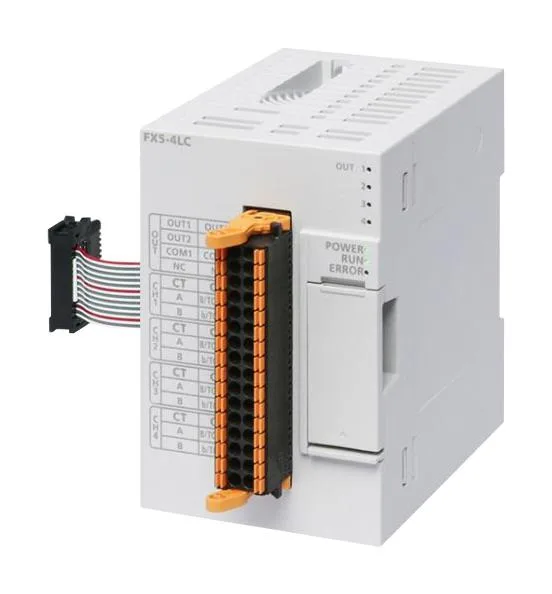
Mitsubishi FX5-4LC PID Control Module, 4 I/O
MPNFX5-4LC
Mitsubishi FX5 Series Programmable Logic Controller, Analog Input Module, 4 input points, 4 output points, Two-position control, PID control, Heating/cooling PID control, Cascade control, Weight 0.3 Kg.
$712.00 – $1,093.28Ref. price · indicative, final on quote
Source DocumentedChannel stated on listing & quote
Condition PhotosReal unit photos / video on request
WhatsApp AnswersFast human replies for machine-down parts
Worldwide DispatchDHL/FedEx — transit quoted per order
Independent China distributor & sourcing agent· Listing updated Sep 2026
Specifications
| Parameter | Value |
|---|---|
| Weight | 0.3 Kg |
| Parameter | Value |
|---|---|
| Product type | Programmable Logic Controller |
| Control method | Two-position control, PID control, Heating/cooling PID control, Cascade control |
| Sensor current | Approx. 0.20 mA (When resistance thermometer is used) |
| Input impedance | 1 MO or more |
| Number of input points | 4 points |
| Number of output points | 4 points |
| Number of occupied i (O points) | 8 points |
Product details
Frequently asked questions
What is the Mitsubishi FX5-4LC and what does it do?
First-touch answer that qualifies the buyer and routes hobbyists vs engineers to the right specs.
How do you wire and configure the FX5-4LC in GX Works3?
Combines top wiring-diagram and configuration queries and unblocks commissioning buyers.
How many input and output points does the FX5-4LC have, and what signal types are supported?
Core spec question that drives datasheet engagement and variant selection.
Does the FX5-4LC support PID, cascade, and two-position control, and how is it tuned?
Differentiates FX5-4LC from generic analog modules and is the highest-value commissioning question.
What is the difference between FX5-4LC and FX5-4AD?
Top comparison query; resolving it prevents mis-buy and BOM rework.
Is the FX5-4LC still in production, and what is the recommended replacement or alternate?
Lifecycle answer is the single highest-impact question for EOL, spares, and design-in decisions.
MPN
FX5-4LC