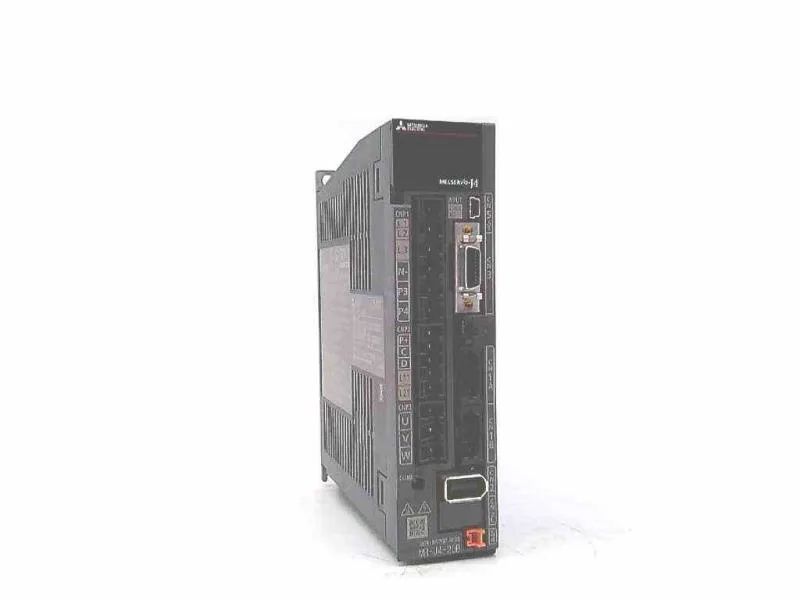
The Mitsubishi MR-J4-20B is a MELSERVO-J4 series servo amplifier rated for 0.2 kW motor output on a 200 V class supply, accepting single-phase or three-phase AC200 V to 240 V at 50/60 Hz. It drives a compatible servo motor via sinusoidal-wave PWM current control and communicates over the SSCNET/H high-speed motion network. The amplifier includes a built-in dynamic brake and integrates STO (Safe Torque Off) per IEC/EN 61800-5-2, with an STO response time of 8 ms or less from input off to energy cut-off. Rated current is listed at 0.2 A (with a separate note value of 1.5 A under specific conditions), and the amplifier draws 30 W of power. The output stage delivers three-phase AC170 V to the motor.
The 0.2 kW motor output rating sizes this amplifier for small-axis applications — think indexing tables, pick-and-place grippers, or conveyor diverters. The 200 V class input (single-phase or three-phase AC200 V to 240 V, ±5 % frequency tolerance) means it fits standard low-voltage industrial mains in most regions, but verify your line voltage stays within the allowable fluctuation of AC170 V to 264 V single-phase. The SSCNET/H interface is a high-speed synchronous serial bus specific to Mitsubishi motion networks. If your controller is not SSCNET/H-capable, this amplifier will not communicate — there is no built-in pulse-train or analog input on this model. The USB port on the front is for PC connection only (MR Configurator2 setup software), not for real-time motion control. STO (Safe Torque Off) per IEC/EN 61800-5-2 with medium diagnostic coverage (DC = 97.6 %) means the amplifier can be integrated into a safety circuit up to a certain performance level without an external safety relay for the torque-off function — useful for clearing jammed material without removing power from the whole cabinet.
Where it goes and what it connects to
Mounts inside a standard IP20 control cabinet. The amplifier accepts a Mitsubishi high-speed serial communication encoder interface on the motor end, and provides ABZ-phase encoder output pulses for external position monitoring. Two analog monitor channels are available for tuning or troubleshooting with an oscilloscope. Power for the control logic comes from a separate DC24 V ± 10 % supply, requiring 0.3 A on the CN8 connector signal. The main power input can be single-phase or three-phase — check Note 6 in the manual for wiring restrictions depending on your configuration.