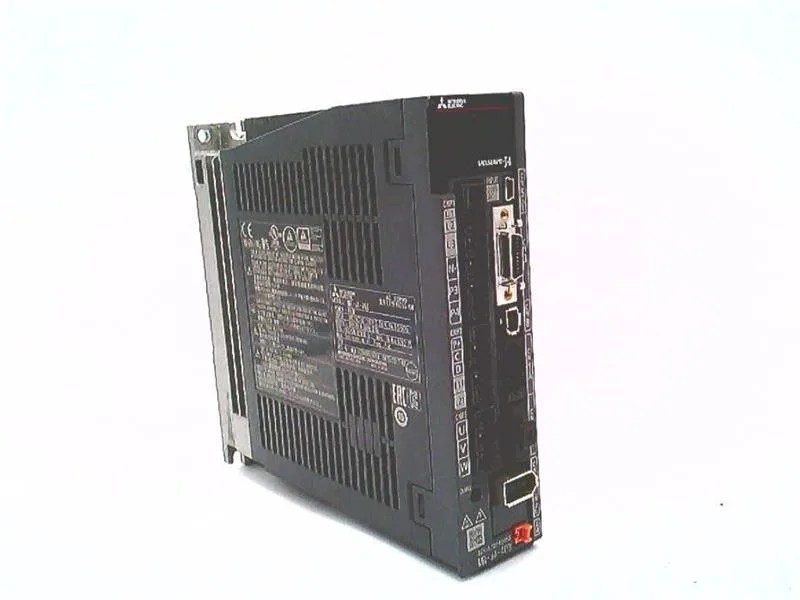
Servo amplifier for a 60B-frame motor
The Mitsubishi MR-J4-60B is a servo amplifier from the MR-J4 series, matched to a 60B-frame motor. Its 3.2 A output rated current at 3-phase 170 VAC drives the motor through sine-wave PWM current control. The main circuit accepts 3-phase or 1-phase 200 VAC to 240 VAC, 50/60 Hz, so it works on a standard 208–240 V industrial supply without a transformer. A built-in dynamic brake stops the motor quickly when the drive is disabled or a fault occurs, which matters for vertical loads or short deceleration profiles where coasting is unsafe. The amplifier supports close mounting to adjacent units, saving panel width. The STO safety function (IEC/EN 61800-5-2) removes torque without removing power from the drive, letting you integrate this into a safety circuit that meets SIL 3 / PL e requirements. The interface supply is 24 VDC ±10% at 0.3 A, including the CN8 connector signal.
The 3.2 A output rated current is the continuous current the amplifier delivers to the motor. Pair it with a servo motor whose rated current is at or below 3.2 A — typically a 400 W to 750 W class motor in the MR-J4 family. The 170 VAC output voltage matches the motor's winding voltage; do not use this amplifier with a 400 V-class motor. The main circuit supply draws 3.2 A at rated load. The control circuit supply draws 0.2 A from a separate 1-phase 200–240 VAC source. Both numbers are needed to size the branch circuit and the control transformer. Mount it inside a panel with at least IP54 enclosure protection. Natural cooling is sufficient at rated current; derate if ambient exceeds 40 °C or if the panel has poor airflow.
Integration notes
Communication is via USB for connection to a PC running MR Configurator2. No fieldbus module is built in; add an optional MR-J4-T or MR-J4-GF bus interface card if you need CC-Link, PROFINET, or EtherCAT. The load-side encoder interface uses Mitsubishi high-speed serial communication — only MR-J4 series motors with the matching encoder connector work.