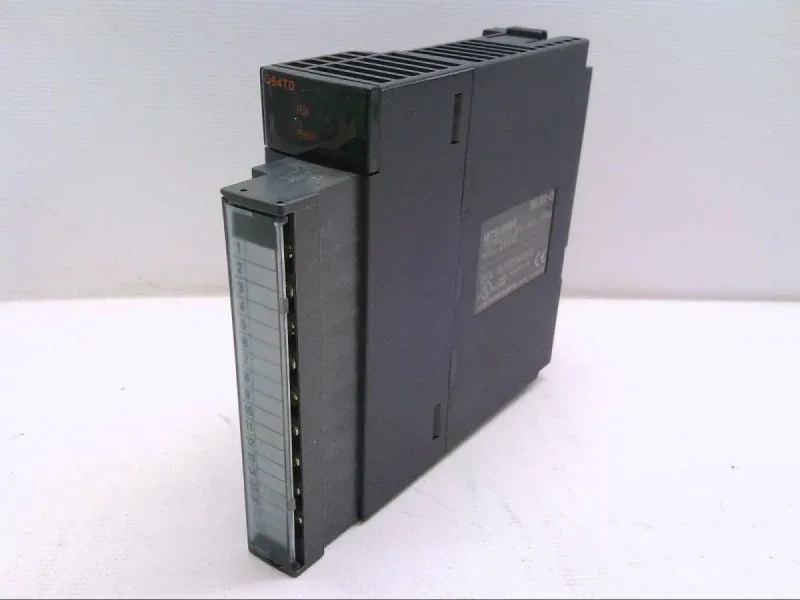
Mitsubishi Electric Q64TD — PLCs (Programmable Logic Controllers)

Mitsubishi Q64TD Thermocouple Input Module, 4-Ch, 0.1°C

MPNQ64TD

Mitsubishi Q-series, Q64TD, 4-channel thermocouple input module, 20 ms/channel sampling, resolution down to 0.1°C (J-type), width 27.4 mm.

$288.00Ref. price · indicative, final on quote
Sourced new & surplus through independent channelsAuthenticity-screened · ESD-safe packingListing updated Aug 2026

Specifications

Q64TD key specifications
ParameterValue
Minute voltage input- Input range : - 100 to +100 mV (input resistance 2 MO or more)
Dielectric breakdown voltageBetween thermocouple input / microvoltage input and sequencer power supply, between thermocouple input / microvoltage input channel: AC 1780 Vrms / 3 cycles (altitude 2000 m)
Micro voltage conversion value16-bit signed binary (-25000 to 25000)
DC 5 v internal current consumption0.50A
External wiring connection method18-point screw terminal block (M3 screw)
Depth112 mm
Width27.4 mm
Height98 mm
Shipping weight1.5 Kg
Thermocouple compliant standardJIS C1602-1995
Mass0.25 kg
Accuracy- Thermocouple type Measurement temperature range : Accuracy (° C) = (conversion accuracy) + (temperature characteristics) × (use ambient temperature change) + (cold junction compensation accuracy) conversion accuracy: Operating ambient temperature 25 ± 5 ° C Temperature characteristics: Operating ambient temperature change 1 ° C use Ambient temperature change: Operating ambient temperature out of the range of 25 ± 5 ° C

All specifications

Q64TD additional specifications
ParameterValue
ResolutionB: 0.7 ° C. R, S: 0.8 ° C. K, T: 0.3 ° C. E: 0.2 ° C. J: 0.1 ° C. N: 0.4 ° C.
0 to 200 °Conversion accuracy: ± 2.0 ° C Temperature characteristics: ± 0.25 ° C Maximum temperature error at 55 ° C ambient temperature: ± 8.25 ° C Influence per 1 O of wiring resistance: 0.003 ° C / O
0 to 300 °Conversion accuracy: ± 4.0 ° C Temperature characteristics: ± 0.4 ° C Maximum temperature error at 55 ° C ambient temperature: ± 14.0 ° C Influence per 1 O wiring resistance: 0.013 ° C / O
0 to 350 °Conversion accuracy: ± 1.5 ° C Temperature characteristics: ± 0.1 ° C Maximum temperature error at 55 ° C ambient temperature: ± 4.0 ° C Influence per 1 O resistance: 0.002 ° C / O
800-1700 °Conversion accuracy: ± 3.5 ° C Temperature characteristics: ± 0.4 ° C Maximum temperature error at 55 ° C ambient temperature: ± 13.5 ° C Influence per 1 O of wiring resistance: 0.010 ° C / O
Scaling value16-bit signed binary
-200 to 0 °Conversion accuracy: ± 2.5 ° C Temperature characteristics: ± 0.25 ° C Maximum temperature error at 55 ° C ambient temperature: ± 8.75 ° C Influence per 1O of wiring resistance: 0.007 ° C / O
Digital output- Measured temperature : 16-bit signed binary (-2700 to 18200: 10 times the value to the first decimal place)
-40 to 200 °Conversion accuracy: ± 1.5 ° C Temperature characteristics: ± 0.15 ° C Maximum temperature error at 55 ° C ambient temperature: ± 5.25 ° C Influence per 1 O resistance: 0.002 ° C / O
200 to 750 °Conversion accuracy: ± 2.0 ° C Temperature characteristics: ± 0.15 ° C Maximum temperature error at 55 ° C ambient temperature: ± 5.75 ° C Influence per 1 O resistance: 0.002 ° C / O
200 to 900 °Conversion accuracy: ± 2.0 ° C Temperature characteristics: ± 0.15 ° C Maximum temperature error at 55 ° C ambient temperature: ± 5.75 ° C Influence per 1 O resistance: 0.001 ° C / O
600 to 800 °Conversion accuracy: ± 4.0 ° C Temperature characteristics: ± 0.4 ° C Maximum temperature error at 55 ° C ambient temperature: ± 14.0 ° C Influence per 1O of wiring resistance: 0.011 ° C / O
Sampling period20 ms / channel
-200 to 200 °Conversion accuracy: ± 1.5 ° C Temperature characteristics: ± 0.15 ° C Maximum temperature error at 55 ° C ambient temperature: ± 5.25 ° C Influence per 1 O resistance: 0.003 ° C / O
200 to 1200 °Conversion accuracy: ± 2.0 ° C Temperature characteristics: ± 0.25 ° C Maximum temperature error at 55 ° C ambient temperature: ± 8.25 ° C Influence per 1O of wiring resistance: 0.002 ° C / O
200 to 1250 °Conversion accuracy: ± 2.5 ° C Temperature characteristics: ± 0.25 ° C Maximum temperature error at 55 ° C ambient temperature: ± 8.75 ° C Influence per 1 O resistance: 0.002 ° C / O
300 to 1600 °Conversion accuracy: ± 3.5 ° C Temperature characteristics: ± 0.4 ° C Maximum temperature error at 55 ° C ambient temperature: ± 13.5 ° C Influence per 1 O of wiring resistance: 0.008 ° C / O
Conversion speedSampling period x 3
Insulation methodBetween thermocouple input / microvoltage input and sequencer power supply: Between transformer insulation thermocouple input / microvoltage input channel: Between transformer insulation cold junction compensation input (Pt100) and sequencer power supply: Non insulation
Channels4 channels
Analog input points4 points (4 channels + cold junction compensation channel)
Estimated lead timeUsually ships in 1 - 10 working days.
Insulation resistanceBetween thermocouple input / microvoltage input and sequencer power supply: DC500V 100MO or more Thermocouple input / microvoltage input channel between DC500V 10MO or more
Absolute maximum input± 5 V
I (O occupancy points)16 points (I / O assignment: Intelli 16 points)
Disconnection detectionYes (each channel independent)
Accuracy cold junction compensation accuracy± 1.0 ° C

Product details

The Mitsubishi Q64TD is a 4-channel thermocouple input module for the Q-series PLC, with resolution down to 0.1°C on J-type thermocouples and a 20 ms per-channel sampling period. Each channel is independent with disconnection detection, and the module occupies 16 I/O points on the backplane. The module accepts standard thermocouple types per JIS C1602-1995, including B, R, S, K, T, E, J, and N, with resolution varying by type: 0.7°C for B, 0.8°C for R/S, 0.3°C for K/T, 0.2°C for E, 0.1°C for J, and 0.4°C for N.

Accuracy characterization

The per-channel accuracy follows a formula: accuracy (°C) = conversion accuracy + (temperature characteristics × use ambient temperature change) + cold junction compensation accuracy. The conversion accuracy is specified at an operating ambient of 25°C ±5°C; outside that range, add the temperature coefficient per 1°C change. Cold junction compensation accuracy is ±1.0°C, which forms the baseline uncertainty for all thermocouple measurements. The digital output is 16-bit signed binary, scaling measured temperature as 10 times the value to the first decimal place, with a range of -2700 to 18200.

Integration details

The module connects via an 18-point screw terminal block (M3 screws) for external wiring. Power draw from the 5 V backplane bus is 0.50 A. Insulation is via transformer between each thermocouple channel and the sequencer power supply, with a dielectric withstand of 1780 Vrms for 3 cycles.

Sourcing

The Q64TD is a mature product in the Mitsubishi Q-series range, sourced to order through our distribution channel.

MPN
Q64TD