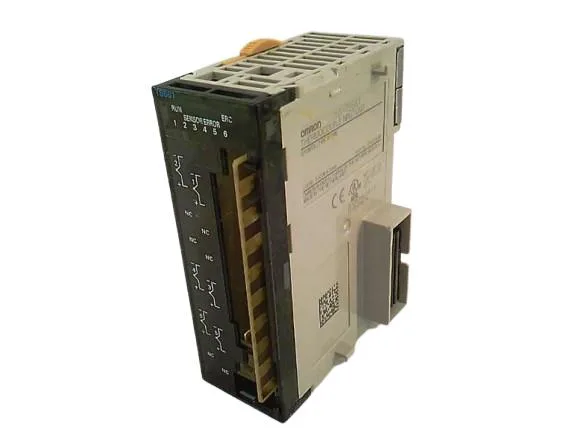
The Omron CJ1W-TS561 is an analog input module on the CJ1W I/O family — six analog inputs landed on screw terminals, slotted into a CJ Series rack next to the CPU and the rest of the local I/O. It carries the same DIN-rail footprint and backplane connector as the rest of the CJ1W lineup, so the mechanical and bus side of the install follows family practice rather than a one-off cutout.
What the key envelope means in the panel
Operating range is 0 °C to 55 °C, which is the standard control-room envelope — the module does not need a cabinet heater or a cold-weather spec derate for a typical indoor cell, but anything outside that band is not on the menu without external conditioning. Termination is screw, not spring-cage or MIL connector, so the wireman is terminating with a standard blade driver rather than pushing ferruled leads into a cage — worth flagging on the wiring diagram if the rest of the rack has migrated to push-in.
Sourcing posture and lifecycle flag
The evidence lists the lifecycle flag but no successor order code; sourcing a like-for-like second source is an integrator step, not a datasheet statement.
Integration checklist for the controls integrator
Slot it on the CJ1W local rack next to the CPU; the analog count is six, so any tag database that assumed two channels (a PTS15 baseline) needs to be re-sized before the rack is powered up. Confirm the analog signal class — voltage, current, or TC/RTD — against the field wiring before termination; the listing names the module as analog input but does not carry the signal-class detail, which is a question for the supplier rather than a guess on the bench. Operating envelope of 0 °C to 55 °C is the standard indoor control-cabinet window; no special derating curve is published in this evidence, so the integrator should follow the family derating note rather than a per-module curve.