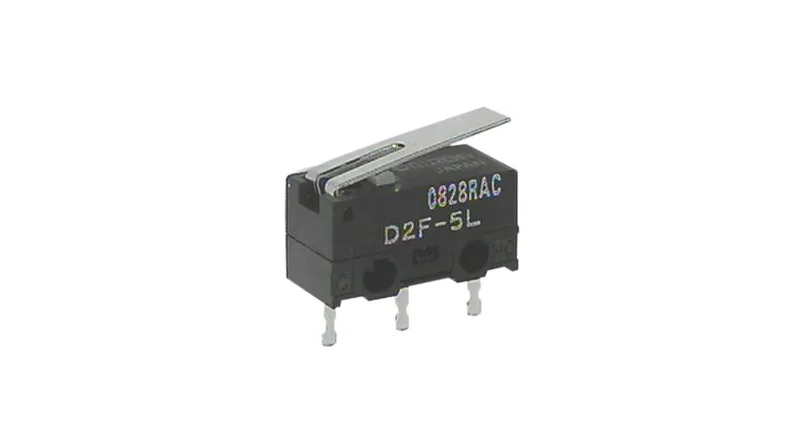
What the D2F-5L actually delivers on the line
The Omron D2F-5L is an ultra-subminiature snap-action limit switch in the D2F series, built around a hinge lever actuator with a 1CO (changeover) contact set wired to PCB pins, rated 5 A at 250 V AC with an actuation force of 1.47 N — the lever geometry is what defines both the over-travel and the position-repetition a detection point needs, so confirm the lever pivot orientation against the cam profile before committing the BOM. At 5 A and 250 V AC, the switch sits comfortably in the control-circuit and small-load signaling range; for anything beyond that — inductive DC loads, motor starters, solenoid coils — a suppressor across the contact is mandatory because the subminiature body has no arc chamber, and a derating curve should be applied above the rated ambient.
Footprint, IP rating, and panel-side integration
Body dimensions are 12.7 mm long by 5.8 mm wide by 5.5 mm high, which is what puts the D2F into the ultra-subminiature bracket — it mounts inside equipment housings where a standard-size limit switch simply does not fit, and the PCB pin termination drops straight through the board for wave or hand soldering without a harness. The IP40 rating is a clear boundary: the body resists finger and tool intrusion but offers no protection against water or dust ingress, so the D2F-5L belongs inside an enclosure or on a guarded fixture — outdoor, washdown, or food-line deployment is not on the table without a sealed housing around it.
Lifecycle read and the spare-in-the-cabinet question
The D2F series is listed as mature, which for a legacy install means the line is still on the manufacturer's books but is no longer a growth product — for installed equipment still running on these switches, the sensible move is to hold a critical spare per asset before a failure rather than wait for a six-week hunt after the line is down.
How the D2F-5L is sourced and quoted
Sourcing runs through independent distribution on a quoted-to-order basis: confirm availability and current pricing against an RFQ rather than assuming a shelf pick, and the same channel handles both small maintenance quantities and panel-build volumes.