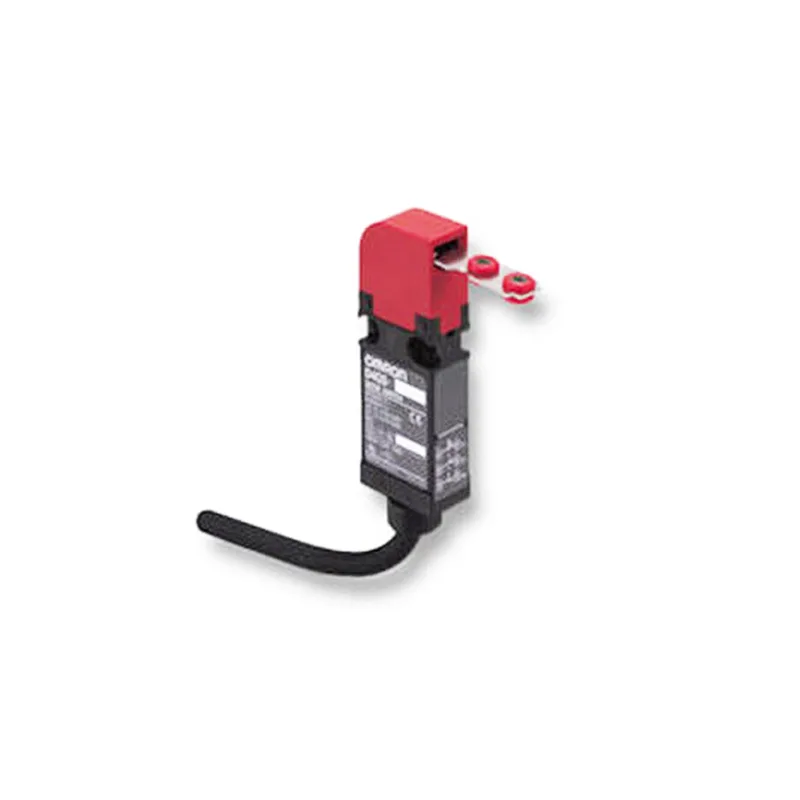
The Omron D4GS-N1T-3 is a slim-profile safety door switch designed for interlocking guard doors on machinery. Its compact body fits into tight extrusion channels where a standard switch won't clear. The built-in switch is a single-pole 1NC/1NO slow-action contact block, meaning the normally-closed channel drops out first on opening — the standard arrangement for a safety circuit that needs a positive-break signal to the safety relay or PLC. Key insertion is vertical (T-type), so the actuator enters from above. This matters when you're laying out the guard-door geometry: the switch body mounts on the fixed frame, the actuator on the door, and the vertical approach dictates the hinge side and door swing. Cable length is 3 m, pre-wired, which saves a junction box on a single-door cell but may need extension for a large enclosure.
The conventional free-air thermal current (Ith) is 2.5 A per EN 60947-5-1. That's the continuous current the contacts can carry in a control circuit — enough for a safety relay input or a 24 VDC PLC sink, but not for direct motor switching. The conditional short-circuit current is 100 A, meaning the switch is protected by a 100 A fuse or breaker upstream without welding its contacts during a fault. That's a coordination spec: it tells the panel builder what overcurrent device the switch expects to see. Operating speed is rated 0.1 to 0.5 m/s. Below 0.1 m/s the slow-action contacts may not snap cleanly, risking arcing on the NC channel. Above 0.5 m/s the mechanical impact can shorten life. The maximum operating frequency is 30 operations per minute — a guard door opened and closed every two seconds, typical for a pick-and-place cell, not a high-cycle press.