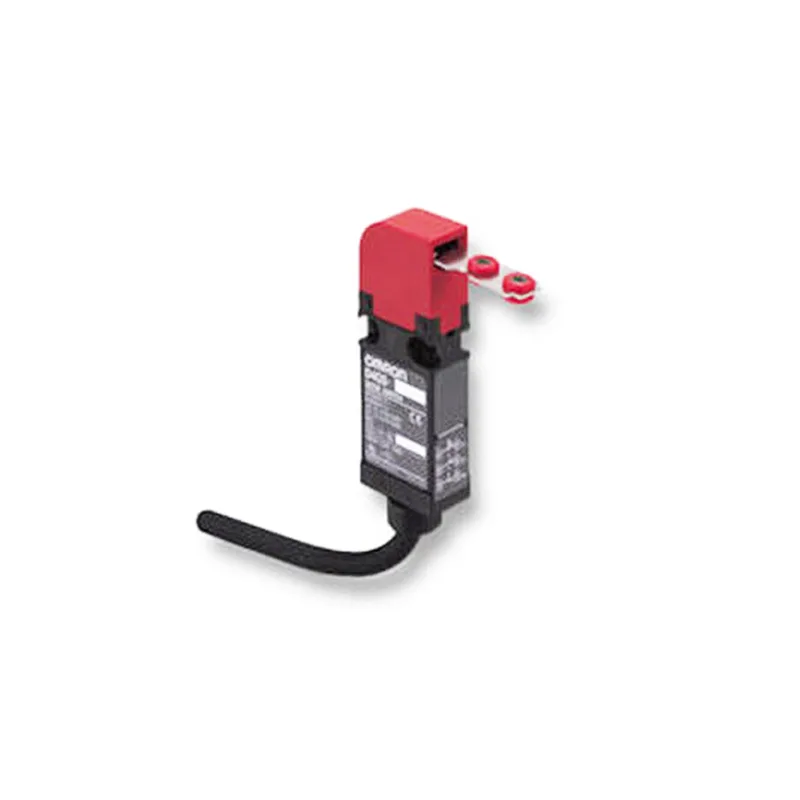
The D4GS-N2R-5 is a slim-profile safety door switch from Omron, built with two normally-closed slow-action contacts (2NC) and a 5-meter cable. It's designed for interlocking guard doors where panel space is tight — the slim body fits where a standard switch won't. The 2NC configuration gives you a redundant safety path, which is what you want for a Category 3 or 4 safety circuit per ISO 13849-1.
The conventional free-air thermal current (Ith) is 2.5 A per EN 60947-5-1. That's the continuous current the contacts can carry in free air — enough for pilot-duty control signals to a safety relay or PLC input, but not for direct motor switching. Operating speed is specified at 0.1 to 0.5 m/s — the actuator must move through that range for reliable contact transfer. Slower or faster and the contacts may not make or break cleanly, which matters for both mechanical life and signal integrity. Maximum operating frequency is 30 operations per minute. That's a mechanical limit — the switch is meant for occasional door cycles, not a high-speed pick-and-place interlock. The key insertion direction is horizontal (R), so the actuator enters from the side, not the front. That affects mounting orientation and cable routing.
Where it belongs in the circuit
This switch sits between the guard door and the safety monitoring device — typically a safety relay or configurable safety controller. The 2NC contacts wire in series to form a dual-channel input. With a 5-meter cable, you get some flexibility in panel placement, but keep the cable away from VFD output lines and high-current busbars; the switch itself is a passive contact block, but induced noise on the cable can cause nuisance trips. Ground the shield at the panel end only.