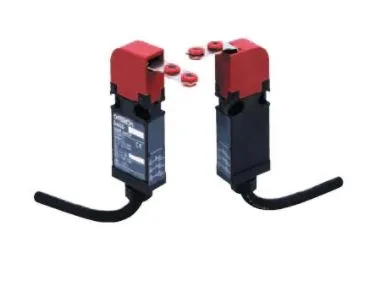
What the D4GSN1R is and what the contact configuration means
The D4GSN1R is a forced break (positive-opening) safety-door switch from Omron's D4GS-N series — the 1NC/1NO contact pair means the normally-closed contact opens under mechanical force when the guard opens, breaking the safety circuit before access is possible, while the normally-open contact signals the door position to the PLC or safety controller. This is the fundamental safety architecture: the NC contact is not reliant on spring return but on the actuator's positive drive, which is what makes it compliant for safety-circuit use under IEC 60947-5-1. The mechanical lock holds the guard shut until the machine's safety cycle completes, so the interlock cannot be bypassed by holding the door partially closed.
Electrical ratings and what the voltage and current ceiling drives
The switch carries a 240 V AC and 250 V DC switching voltage rating, with a 750 mA AC and 270 mA DC current limit. These are not power-handling figures — the contact is designed to interrupt low-power safety circuits, typically 24 VDC control coils, pilot lights, or PLC inputs, not motor loads directly. For a guard-door monitoring circuit running at 24 VDC, the 270 mA DC rating gives comfortable headroom above the typical 50–100 mA pull of a safety relay coil. The 240 VAC rating covers AC-powered safety control panels that use 120/230 V contactor coils; the 750 mA AC rating is sufficient for those coil inrush currents without contact welding.
Endurance and what 100k electric cycles means for guard-door duty
The electric service life is listed at 100,000 cycles and the mechanical at 1,000,000 cycles. The gap between them is typical for a safety switch: the contact wear mechanism (arcing, contact bounce, material transfer) governs the electrical endurance, while the actuator and lock mechanism governs the much longer mechanical life. In a guard-door application where the door is opened and closed every shift, 100,000 cycles translates to roughly 15 years at 15 cycles per operating day — a normal machine life before the switch should be replaced preventively, even if the contacts still function. Budget this replacement interval during scheduled maintenance shutdowns, not as an emergency repair.
IP67, the pre-terminated cable, and what the 30 x 17 x 85 mm body drives in panel fit
IP67 means the switch body and optics withstand temporary immersion — the cable gland is the wet-end seal, so confirm the 1 m cable routing stays above the flood plane in the installation. The pre-terminated 1 m cable eliminates the field termination step and is a deliberate panel-design choice: it routes directly into a field junction box or the safety relay without a separate terminal block, saving a connection point that could be a failure source. At 30 mm deep, 17 mm wide, and 85 mm tall, the switch is compact enough to fit a standard 40 mm EN enclosure channel — check that the actuator entry point aligns with the guard door mechanism before committing to the 1 m cable length, since a 1 m run may need a cable carrier or conduit if the routing path is not direct.