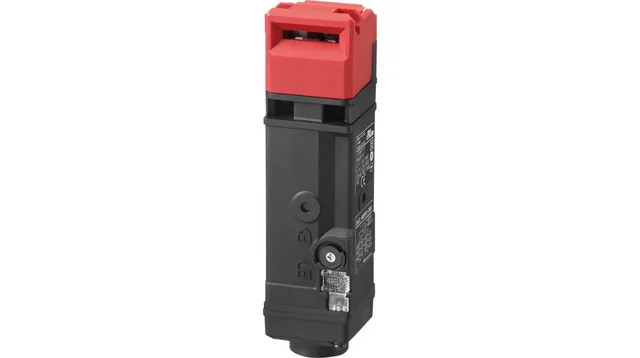
Guard locking — holds the door shut until the safety circuit releases it
The D4SLN4EFADN is a guard lock safety-door switch from Omron's D4SL series. Unlike a basic interlock that only detects the door position, this switch physically locks the guard door closed until the machine controller de-energizes the lock solenoid — preventing access while hazardous motion is still coasting down. The contact configuration is 2 normally-open and 3 normally-closed (2NO/3NC). The NC contacts are the safety-rated channel wired into the safety relay or PLC safety input; the NO contacts signal door-locked status back to the standard control logic.
IP67 and connector termination — built for washdown zones
Rated IP67, the switch body and the connector interface withstand hose-directed water and dust ingress — suitable for food processing, beverage lines, or any area where the guard sees periodic washdown. Termination is via a connector, not a hardwired pigtail. The mating cordset (typically an M12 or similar industrial connector) must be ordered separately; the connector style is not specified here, so confirm the pinout and cordset part number against the machine wiring diagram before ordering.
Switching limits and cycle life — signal-level duty, not power switching
The contacts are rated for 1.5 A at 120 V AC and 220 mA at 125 V DC. This is a signal-level switch feeding a safety PLC or relay input — it is not designed to break motor currents or solenoid loads directly. If the load exceeds these limits, an interposing safety relay or contactor must be used. Electrical life is 150,000 cycles; mechanical life is 1 million cycles. On a high-cycle door (e.g., a packaging machine that opens and closes every 30 seconds), the electrical life is reached in about 1,250 hours of operation — budget a replacement interval accordingly.
Physical fit — 39 mm square body, 155 mm tall
The switch body measures 39 mm wide by 39 mm deep by 155 mm tall. The 39 mm square cross-section fits standard 40 mm panel cutouts; the 155 mm height is the dimension that determines enclosure clearance — ensure the guard frame or enclosure has at least 160 mm of vertical space for the switch body and actuator key travel. The actuator is a key type, and the head can be oriented in four directions — top, bottom, left, or right entry — giving flexibility for different door hinge configurations without changing the switch body.