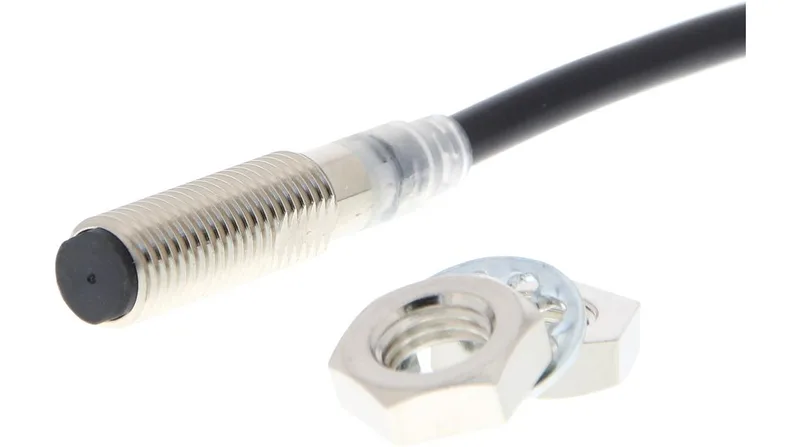
The Omron E2EX3D28T2MOMS is a current-production M8 inductive proximity sensor from the E2E NEXT series. It detects ferrous targets at 3 mm range when flush-mounted in metal, and switches a normally-closed (NC) load at up to 350 Hz. The 2 m flying lead comes pre-wired, saving a connector. Rated 10–30 VDC, 100 mA max load current, IP67 — ready for coolant splash exposure on a machine tool. The NC output opens when a target is present. Verify load within 100 mA and supply 10–30 VDC.
How it compares to similar sensors your BOM might call out
The M12 peer E2EX7D2122MOMS is not a cable-swap replacement. It has a 21 mm hex body vs this unit's 15 mm, and a longer 47 mm can, so it won't drop into the same M8 clearance hole or bracket pocket. It also senses 7 mm instead of 3 mm, which changes target standoff. If the panel is already drilled for M8, you'd need a new sensor holder and possibly a different target cam. The output polarity is the same NC, but the mechanical delta rules out a straight substitution.
For compliance documentation, the E2E NEXT series typically carries RoHS and REACH declarations from Omron. If your incoming quality team needs the specific declaration of conformity or a CE certificate, request it with your RFQ — the sensor itself is marked with the relevant approvals per Omron's standard label.
What to watch during installation
The M8 threaded barrel is flush-mount rated, so you can thread it into a tapped hole in steel without derating the sensing distance — that 3 mm is real against an iron target, not a derated figure. Torque to about 10 N·m; the brass housing will strip if over-tightened. Keep the 2 m cable clear of high-frequency inverter bundles; the sensor itself switches at 350 Hz, but the cable isn't shielded, so route it separately from VFD output lines. At 15 mm wide, it fits in a standard M8 clamp. If you're populating a row of sensors, center-to-center spacing should be at least 30 mm to avoid mutual interference when flush-mounted. The IP67 seal is good for washdown but the cable entry should be pointed downward to avoid water pooling at the gland.