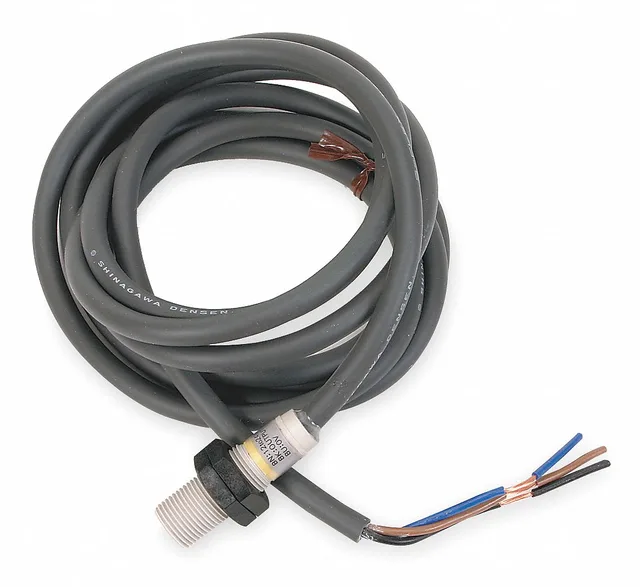
The E2F-X2Y2 is an M12 threaded inductive proximity sensor with a 43 mm overall height and a shielded sensing face — it drops into any standard 12 mm mounting hole and reads through the metal face without side interference. The 2 mm maximum sensing distance is for mild steel at 25 °C; for stainless steel apply a 0.7× correction factor (roughly 1.4 mm), and for aluminium the factor drops to about 0.4× (0.8 mm). If the target is smaller than the sensor face diameter, the range shrinks further. It runs on 20-264V AC, 2-wire, normally-closed output — so when the target is present the output opens, and when the target leaves or power fails the output closes. The load current must sit between 5 mA and 100 mA; below 5 mA the output may not switch cleanly, above 100 mA the internal triac overheats.
IP68 and NEMA 3/4/6 — submersible, not just splash-proof
IP68 means the sensor body and cable entry survive continuous immersion beyond 1 m — the spec sheet typically tests at 1.5 m for 30 minutes. The NEMA 3, 4, and 6 ratings confirm it handles rain, hose-down, and occasional submersion, making it a candidate for washdown zones, outdoor conveyor lines, or tank-level monitoring where water ingress killed a standard IP67 sensor. The polyarylate resin body resists many industrial solvents and oils better than standard ABS or PBT housings — worth noting if the sensor sits near cutting fluid or degreaser spray.
Wiring and compliance — what the 2-wire AC means at the panel
Two wires, AC supply, normally-closed output — the sensor is wired in series with the load (PLC input, relay coil, contactor). When the target is absent, the sensor conducts; when the target is present, it blocks. This is the fail-safe wiring convention: a broken wire or power loss also opens the circuit, same as a target-present condition. The 2 m prewired cable with bare wire ends means no separate connector to source — strip, terminate, and go. The cable jacket is part of the IP68 seal, so cutting it short or adding a splice below the rated immersion depth breaks the protection. Approvals include CCC (China), CE (Europe), CSA (Canada), and cURus (US/Canada) — the sensor carries the marks needed for most industrial control panels shipping into those regions.