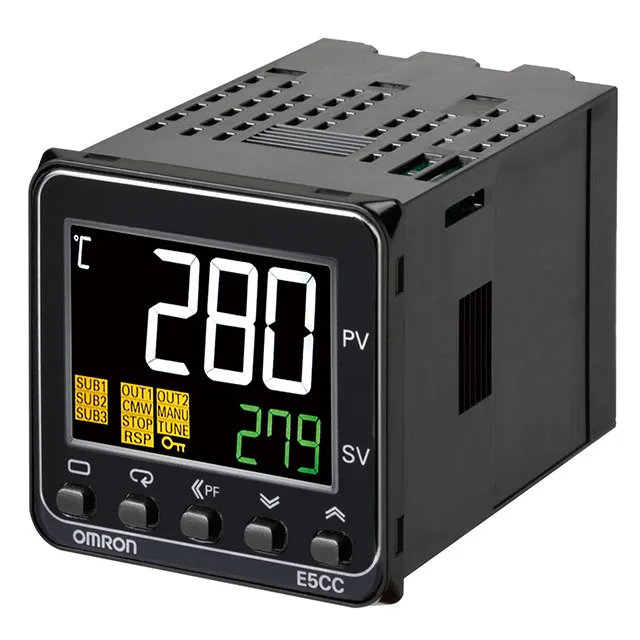
What the output and supply ratings mean for a panel build
The E5CC-TQX3D5M-003: Three relay outputs plus a voltage output for an external SSR — that gives you independent alarm, event, or control loops on the relays while the SSR drive handles the heating element directly. The 24VAC/DC supply means it runs off a common control transformer or a 24VDC power supply without needing a separate AC tap. The RS-485 port speaks both Modbus and CompoWay/F, so it drops into a PLC-based line or a standalone HMI network without a protocol converter.
Sensor input and control flexibility
Accepts RTD, thermocouple types B/E/J/K/L/N/PLII/R/S/T/U/W, plus 0–20 mA or 0–10 VDC process signals — covers the vast majority of temperature and analog process loops on a plant floor. The input range spans -200°C to 2300°C, so it handles both cryogenic and high-temp furnace applications. Control method is selectable between on/off and full PID with auto-tune — the PID loop is what you want for tight temperature regulation on a plastic extruder or a heat-seal bar; on/off is fine for tank heating where overshoot is tolerable.
Heater fault detection and IP66 front — what they mean on the line
Built-in heater fault detection monitors the load current via an external CT and flags a broken heater or SSR short — critical for a food line where a dead heater in a shrink tunnel or oven causes rejects before the temperature drops enough to trigger a normal alarm. The IP66 front panel rating means the controller face withstands hose-down cleaning — standard for food-and-beverage washdown zones where a splash or spray hits the operator interface.