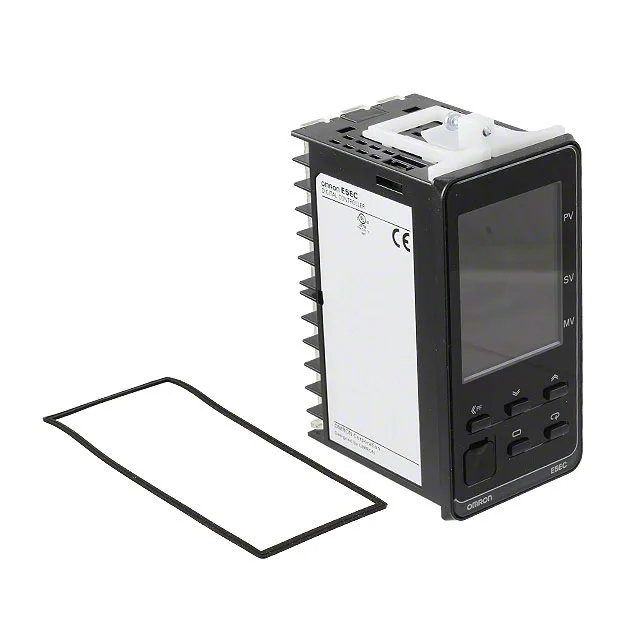
The Omron E5EC-QR4A5M-010 is a 1/8 DIN panel-mount process and temperature controller accepting RTD and thermocouple types B, E, J, K, L, N, PLII, R, S, T, U, W plus 0-20 mA and 0-10 VDC linear inputs. Its input range spans -200°C to 2300°C depending on sensor, making it a single-instrument fit for everything from cryogenic baths to high-temp furnace zones. Control output is a relay (5 A) plus a voltage pulse for driving an external SSR — the relay handles the alarm or on/off stage while the SSR output runs the PID loop, a common split for heater zones where you want solid-state switching without the cost of a built-in high-current SSR. The front panel carries an IP66 rating, so it withstands washdown spray and dust ingress on a machine face. Screw-terminal connection on the back keeps field wiring straightforward — no special crimp tool needed.
Compared to the E5EC-QR4D5M-010, the only difference is the supply voltage: this unit runs on 100-240 VAC, while the -D5M variant takes 24 VAC/DC. If your panel already carries a 24 V control bus, the -D5M saves a transformer tap; if you are wiring direct from line voltage, this -A5M version avoids an extra power supply. The E5EC-QX4A5M-011 swaps the 5 A relay for a fourth relay and drops the dedicated SSR voltage output — useful if you need more alarm contacts and are switching the load with a contactor rather than an SSR.
The E5EC-QR4A5M-010 carries an active lifecycle status. It is a current-production Omron part, not a phase-out or NRND item, so it remains a valid BOM line for new panel builds and replacement spares alike.
Panel cutout is 92.00 mm x 45.00 mm, the standard 1/8 DIN footprint. The tri-color LCD backlight shows four characters per row across three rows — enough to display process value, setpoint, and an alarm status simultaneously. Event input and heater fault detection are built in. The event input can switch between two setpoints or start/stop a program; heater fault detection monitors current draw through an external CT to flag a broken heater element before the process drifts.