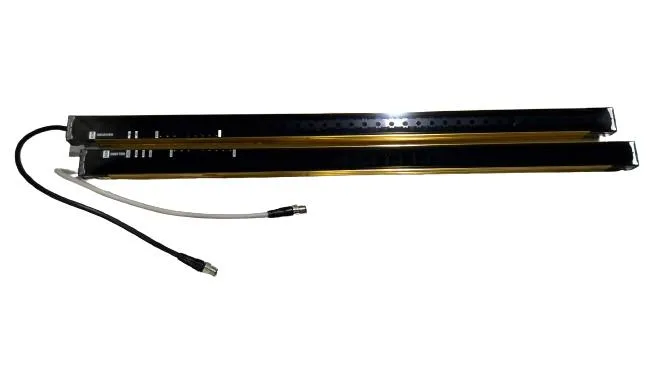
What this F3SJ-A0660P25-TS covers on the line
The Omron F3SJ-A0660P25-TS is a Type 4 safety light curtain rated for hand detection at 25 mm resolution. That 25 mm detection capability means it catches a hand or finger reaching through the sensing field before it enters a hazard zone, meeting the finger-protection class under IEC 61496-1. The 660 mm protective height covers a typical conveyor infeed or machine opening, and the 33 beams at 20 mm pitch give you continuous coverage across that span. Operating range spans 0.2 m to 9.0 m, so it works in tight pick-and-place cells or across wider machine access points. The IP65 rating means the emitter and receiver housings are dust-tight and protected against water jets — suitable for washdown environments in food processing or automotive machining lines where you hose down the guarding perimeter.
Detection capability of 25 mm is the spec that governs the safety distance calculation per ISO 13855. For a 25 mm resolution light curtain, the minimum mounting distance from the hazard is shorter than for a 14 mm finger curtain but tighter than a 40 mm hand curtain — it's the sweet spot for hand access where you don't need full finger-level resolution. The 20 mm beam pitch between the 33 beams means no gaps larger than 20 mm in the sensing field, so a 25 mm diameter object is reliably detected anywhere along the 660 mm protective height. Supply voltage is 24 VDC, standard for safety circuits in modern control panels.
Built-in blanking and muting
This curtain includes blanking and muting function. Blanking lets you optically bypass selected beams for fixed obstructions like a machine frame member passing through the sensing field — you don't lose the entire curtain because one beam is blocked by a bracket. Muting temporarily overrides the safety output when a workpiece or pallet enters the field under controlled conditions, keeping production flowing while the operator is still protected from body intrusion. Both features are configured through the controller, not hard-wired, so you can adjust them during commissioning without rewiring.