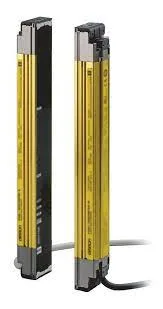
What this light curtain does on the line
Its 55 mm detection capability and 50 mm beam pitch mean it catches a full leg or torso, but not individual fingers — that's the difference between a Type 2 and Type 4 curtain in practice.
Range and environment — will it survive the route?
The operating range spans 0.2 m to 9.0 m, which covers most machine access points from a few feet away to nearly thirty feet. That's enough for a conveyor infeed or a press cell gate. The IP65 rating means it's dust-tight and handles hose-down spray — not a full pressure wash, but it'll survive the splashing and dust you see on a packaging line or a machining center. I've buried plenty of sensors that weren't sealed this well; this one will keep running as long as you don't submerge it.
Power and temperature — keeps working in the heat
Runs on 24 VDC, standard for safety circuits, and stays within spec from -10°C to 55°C. That temperature range covers most factory floors, but if your line sits next to a hot process oven or a foundry, you'll want to check the ambient at the mounting point — 55°C is about 130°F, and the curtain's electronics will derate above that.
Built-in features for real-world guarding
This curtain includes blanking and muting functions. Blanking lets you ignore fixed obstructions — like a machine frame or a part fixture that breaks the beam — without disabling the whole curtain. Muting temporarily suspends the safety output when a workpiece passes through on a conveyor, so the machine doesn't fault out during normal production. Both are handy on automated lines where you can't have the curtain tripping every time a part goes past.