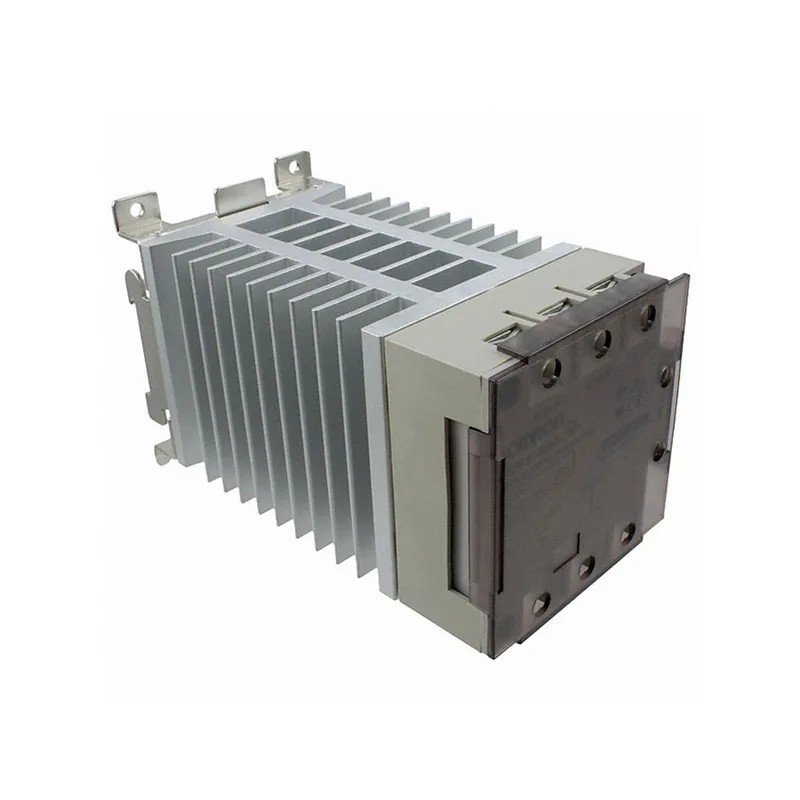
The Omron G3PE-515B-2N is a three-phase solid state relay designed specifically for heater control — not a general-purpose motor switch, so don't try to use it for inductive loads like contactors or small motors. It switches resistive heater loads up to 15 A per phase at line voltages from 200 to 480 VAC, which covers most industrial heating applications on 208, 240, 400, or 480 V three-phase systems. The zero-cross function means it turns on only when the AC sine wave crosses zero, which minimizes electrical noise and inrush current — a good thing for heater banks where you don't want RFI hash radiating into nearby PLC or sensor wiring.
Control side — what the DC input needs
The control input is a 12 to 24 VDC nominal signal, with an operating range of 9.6 to 30 VDC. That means it'll reliably pick up from a standard 24 VDC PLC output card, and it has some headroom if your supply runs a little high. The input only draws 10 mA max at 24 VDC, so you can drive it directly from most transistor outputs without needing an interposing relay. One detail worth flagging for a junior: the release voltage is 1 VDC minimum — so if your control signal leaks or floats above ground, the SSR might not turn off cleanly. Make sure your PLC output goes solidly below 1 V when de-energized.
Load side — heater sizing and inrush
On the load side, this SSR handles 15 A continuous per phase at 40°C ambient. That's a 12.5 kW heater at 480 V three-phase (15 A × 480 V × √3 ≈ 12.5 kW). The minimum load current is 0.5 A, so it won't work well with very small heaters or pilot loads below half an amp — you'll get erratic switching. It can survive inrush of 220 A for one cycle (60 Hz), and the I²t rating of 260 A²s tells you the fuse or breaker upstream needs to coordinate so the SSR's semiconductor junction doesn't cook before the overcurrent device clears a fault. Use semiconductor fuses (gR or aR class) for best protection.