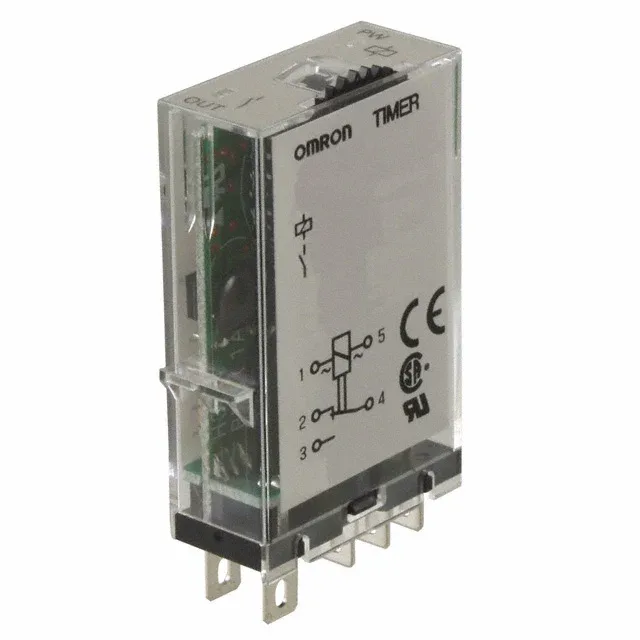
Sourcing the H3RN-21 AC24 from active stock
The H3RN-21 AC24 sits in Omron's H3RN timer family and is listed as Active in production, so the part is not on a last-time-buy clock — quantities can be specified into the BOM and quoted through independent distribution against an RFQ. Lifecycle is recorded as mature within the family, meaning the design is stable and second-source substitutes are unlikely to be announced. Buyers searching by this exact order code are typically chasing a line-side replacement or a new panel build, and the supply reality here is straightforward: active part, quoted to order, availability confirmed at quote time.
Contact rating and what it switches
Output is DPST-NO (2 Form A) via a mechanical relay, rated 3A at 250VAC per contact — that figure is the ceiling for resistive and lightly inductive loads on each pole, and it tells you the timer is sized for control-circuit duty (solenoids, contactors, indicator lamps, small heaters) rather than for switching motor feeders directly. Two isolated Form A outputs let one timer drive two independent loads, or be wired in series for a higher-current single load where the contact rating permits.
Timing range and how it is set
Programmable delay spans 0.1 minutes to 10 hours, set via thumbwheel switches on the front face — the wide range covers short-cycle machine sequencing (fractions of a minute) up to long batch-process timing (multi-hour soak/dwell) on a single catalog code. Multi-function programming means the same unit can run on-delay, off-delay, interval, or repeat-cycle modes depending on the DIP setting, which is why one H3RN code often replaces several single-function timers in a panel BOM. Timing initiates on input voltage — the supply to the timer coil itself is the start trigger — so the 24VAC rail doubles as both power and start signal. That simplifies wiring in control cabinets where a separate trigger contact would otherwise be needed.
Panel mounting and wiring
Socketable mounting with plug-in termination means the H3RN-21 AC24 drops into a standard 11-pin or compatible round-pin timer socket on the DIN rail — the relay body unclips for swap-out without disturbing the field wiring, which is what a maintenance tech wants when a line is down. The 24VAC coil matches the common control transformer secondary found in most industrial panels, so it lands on the same rail as the rest of the control gear without an extra DC supply.