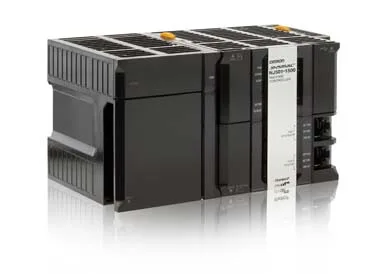
What the NJ501-4500 is built for
The NJ501-4500 is an NJ5 Series machine automation controller — it runs a full cell, not just a relay ladder. With 20 MB of program capacity and a minimum cycle time of 0.5 ms, it sits above commodity PLCs in the BOM hierarchy; this is the CPU that owns a delta-robot pick-and-place cell, a coordinated motion axis group, or a semiconductor handler. EtherCAT is the motion control network, and the 64 coordinated axes with zero point-to-point axes tells you exactly what topology this unit targets: synchronized delta kinematics, not general point-to-point positioning.
Built-in EtherCAT and EtherNet/IP — what drops out of the BOM
EtherCAT and EtherNet/IP are built into the NJ501-4500 — there is no motion control network card to order, no slot allocation decision, and no firmware bundle to manage. EtherCAT handles the real-time motion bus (64 coordinated axes, delta robot topology); EtherNet/IP handles the higher-level plant network. For a buyer writing a BOM, those two network functions are already covered by this one controller, which simplifies the accessories tab and reduces the card count in the enclosure.
Delta robot control and programming flexibility
The NJ501-4500 carries delta robot control as its named special function — not a general-purpose positioning profile, but a dedicated delta kinematic mode. Programming supports ladder, structured text, and function block, so the same CPU can host the motion logic in FBD and the supervisory sequence in ST. Programming connection is USB or Ethernet; the flash memory port is SD, which is the standard media for project backup and firmware updates on the shop floor. DIN Rail mounting keeps it compatible with standard OMRON terminal blocks and distribution blocks already on the panel.
Scaling rules — 10 units per rack, 40 total per CPU
The maximum configuration is 10 units per CPU or expansion rack, with 40 total units per CPU. The 40-unit ceiling per CPU is the hard limit before a second CPU domain is needed.
The NJ501-4500 is listed as active — no LTB watch, no last-time-buy date, no NRND flag in the current record. For a buyer sourcing this exact order code against a BOM line, the procurement signal is clean: it is orderable to specification, quoted to requirement, and backed by OMRON's current channel.