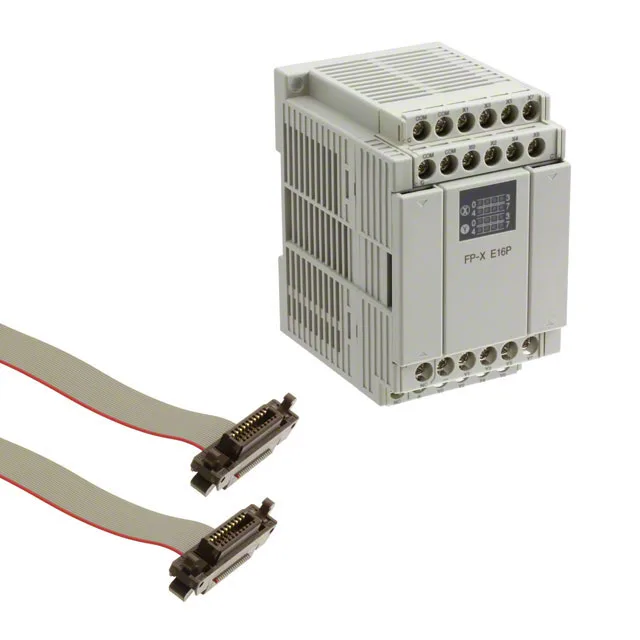
The Panasonic AFPX-E16P is an I/O module in the FP-X series, packing 8 digital inputs and 8 solid-state outputs into a DIN-rail-mount package with screw terminals. This is the part you spec when you need the switching speed and longevity of solid-state outputs rather than relay contacts — no mechanical wear, no contact bounce, and a much higher cycle life for applications like high-speed counting or solenoid banks that hammer the output every scan.
The 8 solid-state outputs are the headline feature here. Unlike the relay-output sibling AFPX-E16R, which gives you mechanical contacts rated for maybe a few hundred thousand cycles at rated load, the solid-state outputs on the E16P handle millions of operations without degradation. That matters when you're switching a valve that cycles every few seconds on a conveyor line — relay contacts would be a quarterly PM item; solid-state runs until the PLC gets swapped. The 8 digital inputs are standard sink/source 24 VDC, same as the rest of the FP-X family, so your existing field wiring from a 16-point input module like the AFPX-E16X transfers straight over — same terminal layout, same screw-clamp pitch. Operating range of 0°C to 55°C covers the typical non-condensing panel environment. If the panel sits in a mill building where ambient hits 50°C in summer, you're still inside the spec — no derating needed at the top end. The DIN-rail mount snaps onto standard 35 mm rail; screw terminals accept up to 1.5 mm² stranded, which is adequate for the 0.5 A per-output typical of solid-state channels. Keep the wiring tidy — the module draws its power from the FP-X backplane, not a separate supply, so no extra breaker needed in the panel.
If you're replacing an AFPX-E16T (transistor-output sibling) on a BOM, the E16P drops into the same panel footprint — same DIN-rail clip, same screw-terminal layout, same 8-input/8-output count. The difference is the output driver: the E16T uses NPN open-collector transistors (sinking), while the E16P uses solid-state outputs that are typically sourcing (PNP). Verify your load common polarity before swapping — a sinking-output field device wired to a sourcing module won't pull in. The relay-output AFPX-E16R is the easiest swap if you don't need the cycle life; it's a straight pin-for-pin replacement with no polarity concern, but you lose the solid-state endurance.