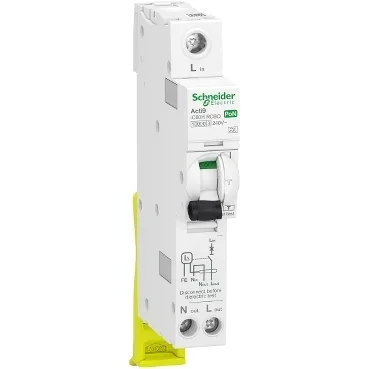
The Schneider Electric A9D01840 is an Acti9 iC60 RCBO — a combined residual current breaker with overcurrent protection in a single 2-module (36 mm) wide package. It's a 1P + Ns (switched neutral) unit rated 40 A at 50 °C with a C-curve trip characteristic (magnetic tripping between 5 and 10 times In). The integrated earth-leakage protection is set at 10 mA sensitivity.
If your panel ambient runs hotter than 50 °C, you need to derate — the spec doesn't give a curve here, but the thermal-magnetic bimetal responds to ambient. The C-curve (5-10x In magnetic trip) is the standard for general-purpose circuits with moderate inrush — lighting banks, small motor loads, socket outlets. It's not for transformer or motor-start duty where you'd want a D-curve, nor for purely resistive loads where a B-curve might suffice. That's the Icn rating per IEC 61009-2-2 — the standard for RCBOs. For a domestic or light commercial distribution board fed from a transformer with typical fault levels under 6 kA, this gives headroom. If your service entrance has a higher fault current, you'd need to check the Ics (service breaking capacity) or coordinate with an upstream MCCB. The 10 mA earth leakage sensitivity means it will trip on low leakage currents. This is appropriate for circuits where direct contact with live parts is possible.
The A9D01840 mounts via plug-on connection to an Isobar A or Isobar B busbar system — that's the standard Schneider Acti9 distribution board arrangement. It occupies 2 module pitches (9 mm each, so 18 mm total width per module, 36 mm for the unit). Terminals are screw-clamp type. Top connection accepts 1 to 25 mm² rigid or 1 to 16 mm² flexible; bottom connection accepts 1 to 16 mm² rigid or 1 to 10 mm² flexible. Strip length is 14 mm for top connections, 13 mm for bottom. These are standard values for a 40 A device — the top terminal is slightly more generous to accommodate incoming supply conductors. IP20 rated per IEC 60529 (finger-safe), with IP40 in a modular enclosure. That's standard for DIN-rail mounted devices inside a distribution board — no special washdown or outdoor rating. The device includes local fault indication and ON/OFF status signaling via a toggle control.
Durability and environmental
Rated for 5000 electrical cycles and 20,000 mechanical cycles. That's the expected life under rated load at rated voltage — not a guarantee, but a design target. For a final-circuit RCBO in a residential panel that sees maybe a few operations per year, that's effectively a lifetime part. For a frequently switched industrial circuit, you'd want to check the cycle count against your expected operations. Overvoltage category II (distribution board level). Limitation class 3 indicates energy limiting performance — the device limits let-through energy in a short-circuit condition, which helps with downstream coordination.