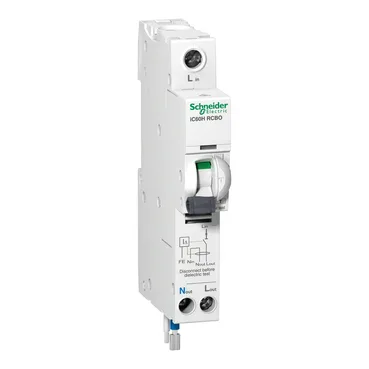
No need to rework the enclosure layout if you're swapping in a standard single-module width. The thermal-magnetic trip unit gives you the familiar bimetal-plus-solenoid response: no electronics to fail in high-ambient or dirty environments.
The 45 A rating at 50 °C means this RCBO is already de-rated for a warm enclosure. The C-curve trips between 5 and 10 times In — so a 45 A C-curve holds through a 225 A to 450 A surge for short-duration motor starts or capacitor inrush, then clears a hard fault. The 30 mA residual sensitivity is the standard for socket-outlet and general-purpose circuits where direct contact protection is required per IEC 61009-1. It's integrated into the same housing — no separate RCD module needed, which saves a DIN position. Limitation class 3 means this device limits the let-through energy under fault conditions, which helps with downstream coordination and reduces stress on wiring and connected equipment. The 250 A surge current rating covers the magnetizing inrush of a small transformer or the charging current of a power-supply capacitor bank.
Wire stripping length is 14 mm for the top connection, 13 mm for the bottom. The screw-clamp terminals are the traditional cage type — reliable, field-serviceable, and compatible with standard ferrule crimps. The device is padlockable with a 4 mm Ø padlock for lockout/tagout during maintenance.
Standards compliance covers IEC 61009-1 and IEC 61009-2-2 — the international standard for RCBOs. The device is suitable for isolation, meaning it can be used as a disconnecting means for the outgoing circuit when padlocked off. For a final-distribution RCBO that sees occasional switching, that's a long service life.