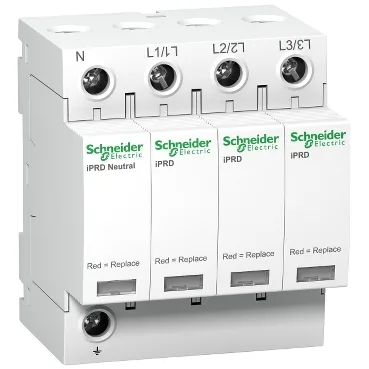
The A9L20621 is a Type 2 surge arrester from the Acti9 iPRD20r range, built for IT earthing systems in distribution panels. It uses MOV + GDT technology to clamp line-to-PE and line-to-neutral surges, with a maximum discharge current of 20 kA per mode and a nominal discharge of 5 kA. Rated at 230/400 V AC (+/-10%), it's a 3P+N unit that clips onto a DIN rail — no special tools, just snap it in and torque the tunnel terminals to 3.5 N·m.
The 20 kA max discharge (common mode L/PE and N/PE) tells you this arrester can handle a direct lightning strike up to that level without failing catastrophically — but the nominal 5 kA is what it'll see in everyday switching transients. The Uc of 460 V L/PE and 260 V N/PE means it won't degrade under normal line voltage, and the TOV withstand of 337 V L/N for 5 seconds gives you a window before it goes into safe failure mode at 1453 V L/PE. That's important for IT networks where a first fault doesn't trip the supply. The short-circuit withstand of 5 kA at 415 V Ph/Ph means you need an upstream overcurrent device — the manufacturer specifies an iC60L 10 A curve C breaker (Icu 25 kA) or a gG fuse up to 80 A. Without that coordination, a fault downstream could weld the arrester's internal disconnector. The remote signalling contact (1 C/O, rated 0.25 A/250 V AC) lets a PLC or SCADA system know when the cartridge has reached end of life.
The clip-on DIN rail mount (9 mm pitch, 8 modules wide) means it occupies 72 mm of rail space — standard for a 3P+N arrester with remote signalling. The tunnel terminals accept 2.5 to 25 mm² rigid or 4 to 16 mm² flexible on both top and bottom, so you can daisy-chain the PE busbar without extra connectors. The white RAL 9003 housing matches the rest of the Acti9 range.