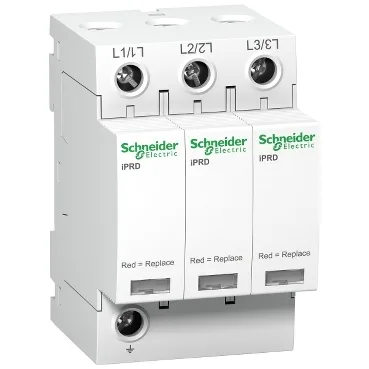
The Schneider Electric A9L40301 is an Acti9 iPRD40r Type 2 surge arrester, a 3-pole unit with a pluggable MOV cartridge rated for 40 kA maximum discharge current (common mode L/PE) and 15 kA nominal (L/PE and N/PE). It is designed for 400 V AC (+/-10%) TN-C and IT 230 V earthing systems, with a maximum continuous operating voltage of 350 V L/PE.
The 40 kA Imax (maximum discharge current) tells you the worst-case surge this unit can survive once and still function — it's the 'one big hit' rating. The 15 kA In (nominal discharge current) is the working rating: the surge level the arrester can handle repeatedly over its life without degrading. For a Type 2 device installed at a sub-distribution board, 15 kA In is typical for protecting against switching transients and indirect lightning strikes. The voltage protection level Up < 1.6 kV (L/PE) means the arrester clamps the surge voltage to under 1.6 kV, which is within the impulse withstand of most downstream equipment rated for 2.5 kV or higher. The 350 V Uc (continuous operating voltage) is the maximum steady-state voltage the MOV can sit across without overheating — at 400 V nominal, this gives about 12% headroom above the nominal phase-to-neutral voltage, which is standard for TN systems.
Clip-on DIN rail mounting (standard 35 mm profile). Tunnel-type terminals top and bottom accept 2.5 to 35 mm² conductors; tightening torque is 2.5 N·m. The remote signalling contact (1 C/O) is rated 0.25 A / 250 V AC — enough to drive a PLC input or a panel indicator lamp. Operating temperature range is -25 to +60 °C, storage -40 to +85 °C, with 5–95% relative humidity non-condensing. The IK03 impact rating (IEC 62262) means it withstands 0.35 J — standard for enclosed panel gear.
Designed and tested to EN 61643-11:2012 and IEC 61643-11:2011 — the core standards for low-voltage surge protective devices. Carries NF and KEMA-KEUR quality marks, which are recognised across European and some international installations. The temporary overvoltage withstand (Ut) is 337 V L/N for 5 seconds (safe operation) and 1200 V N/PE for 200 ms (safe failure mode). Ground leakage current is 0.6 mA typical, 0.003 mA in normal operation — negligible for RCD coordination.