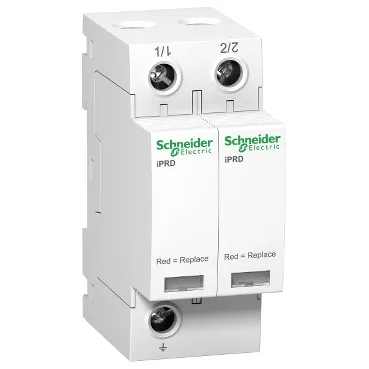
It carries a 20 kA nominal discharge current per mode (L/PE, N/PE) and a 65 kA maximum discharge current, which means it handles the bulk of lightning-induced surges at the main or sub-distribution board without passing through to downstream equipment. The 230 V AC (+/-10%) rated operational voltage and 350 V maximum continuous operating voltage (Uc) match standard single-phase European mains; the 337 V temporary overvoltage (TOV) withstand for 5 seconds gives it a realistic ride-through for utility switching events before it safely fails.
Clip-on DIN rail mounting and a 36 mm width mean it occupies two standard 18 mm modular pitches — check your enclosure's fill factor before the outage window. Tunnel-type terminals accept 2.5 to 35 mm² on both the line and load sides; tighten to 2.5 N·m. The 69 mm depth and 85 mm height leave clearance for wiring ducts and adjacent breakers. Four 9 mm pitches align with the Acti9 comb-busbar system for phase distribution.
Coordination and disconnector
This SPD requires an upstream overcurrent protective device. Schneider lists compatible disconnectors: an IC60N or iC60H (50 A curve C, Icu 10 kA or 15 kA), NG125N/H/L (50 A curve C, Icu 25/36/50 kA), or a gG 80 A fuse (Icu 50 kA). The choice governs the fault-clearing capability at the board — match the Icu to your available fault current. The remote signalling contact (1 C/O, 0.25 A / 250 V AC) lets a PLC or BMS monitor the cartridge status without opening the panel.