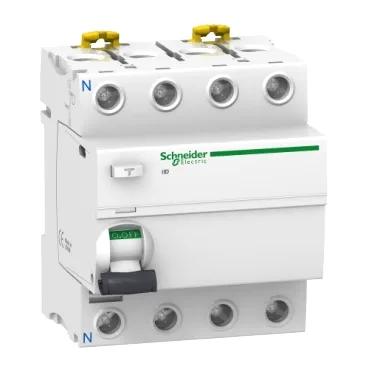
It clips onto the rail, neutral on the left, and handles up to 63 A continuous at 400-415 V AC 50 Hz. That 63 A rating means it's sized for a main incoming or high-current subfeed in a distribution board, not a final subcircuit. The 100 mA earth-leakage sensitivity suits it for general protection where a 30 mA unit would nuisance-trip on leakage from long cable runs or equipment with natural capacitance.
That's fine for standard resistive, inductive, and lighting loads, but not for variable-speed drives, UPS systems, or EV chargers that generate DC fault currents. For those, you'd need a Type A or Type B RCCB. The voltage-independent trip means the device doesn't need a power supply to operate; it draws its trip energy from the fault current itself, so it works even if the neutral is lost upstream. Breaking capacity is rated at 1500 A (Idm and Im). In a typical domestic or light commercial distribution board with a 10 kA upstream MCB, this RCCB is adequately backed — the MCB clears higher faults before the RCCB sees them. The 8/20 µs impulse withstand of 250 A means it survives lightning-induced surges on the line without tripping or damage. Rated insulation voltage (Ui) is 500 V AC, so the device is suitable for 400/415 V systems with headroom.
Mounting and wiring — what fits on the rail
Width is 72 mm, which is four 18 mm modules — the standard 4-pole width for a 4P RCCB in the Acti9 range. Depth is 74.5 mm, height 96 mm. The toggle control on the front gives a clear contact-position indicator. Strip length is 14 mm. That's enough for a 25 mm² incoming feed on a 63 A circuit. The white colour matches the rest of the Acti9 range. IP20 on the device body, IP40 inside a modular enclosure. That's standard for panel-mount gear — not for wet or outdoor locations without an additional enclosure.