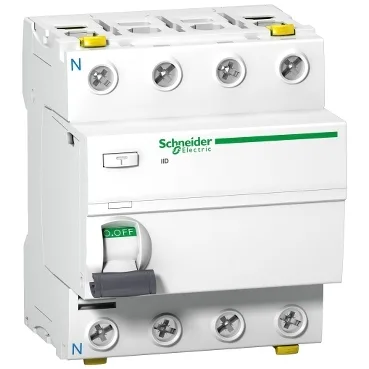
The Schneider Electric A9Z25463 is a 4-pole residual current circuit breaker (RCCB) from the Acti9 iID family, rated 63 A with 300 mA earth-leakage sensitivity. The 300 mA sensitivity is the standard threshold for fire protection in commercial and industrial circuits — it won't trip on the normal leakage of a motor or a long cable run, but it will clear a ground fault that could arc and ignite. The 63 A continuous rating matches a typical submain or feeder in a distribution board, sized for a group of smaller branch circuits. That makes it the right choice for circuits feeding electronic loads, not just resistive heaters or lighting. The 'selective' time delay (marked S) means this RCCB is designed for coordination with downstream RCCBs. It holds during a short-duration fault on a sub-circuit, letting the downstream device clear first. That keeps the main board live and avoids a whole-panel blackout for a single branch fault.
Neutral on the left. The 72 mm width means it takes up eight 9 mm slots in the enclosure — plan your rail space accordingly. IP20 on the body, IP40 inside a modular enclosure.
Breaking capacity and fault handling
Rated conditional short-circuit current is 10 kA — that's the maximum prospective fault current the RCCB can withstand when backed by an upstream overcurrent device (MCB or fuse). The impulse withstand is 3000 A at 8/20 µs, per EN/IEC 61008-1. Voltage-independent tripping means the RCCB detects and clears a residual fault even if the phase voltage collapses — no auxiliary supply needed. That's a reliability advantage over electronic RCCBs in circuits where loss of neutral is possible.
Compliance documentation per EN/IEC 61008-1 and EN/IEC 61008-2-1 is available from the manufacturer.