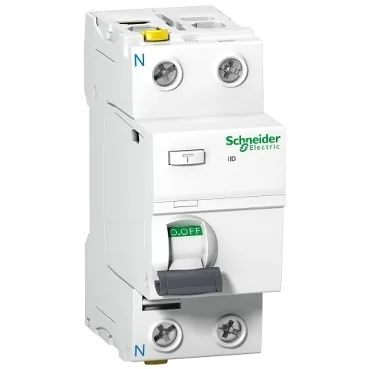
That 30 mA sensitivity covers the standard human-body protection threshold per IEC 60364, so it's the go-to for general socket-outlet and lighting circuits where you need to clear a ground fault before it becomes a shock hazard. That's a standard panel footprint — no surprises when you're swapping into an existing Acti9 distribution board.
The 80 A [In] is the continuous current the RCCB can carry without derating at 40 °C ambient. It's sized for a main incomer on a sub-distribution board or a heavy feeder — think a workshop, a small commercial kitchen, or a pump house. The 10 kA rated conditional short-circuit current (IEC 61008-1) means it can survive a 10 kA fault downstream as long as an upstream overcurrent device (MCB or fuse) clears it; the RCCB itself does not have integral overcurrent protection, so it always pairs with a breaker or fuse ahead of it. The earth-leakage sensitivity is 30 mA, instantaneous trip — no intentional delay. That's the standard for personal protection in most residential and commercial installations. If your panel feeds a lot of electronics, this is the variant that stays latched when a standard Type A would drop out. The breaking capacity (Idm / Im) is 1500 A — that's the maximum fault current the RCCB can interrupt on its own. In practice, the 10 kA conditional rating with an upstream protective device is the number that governs coordination. The 6 kV impulse withstand (Uimp) and pollution degree 3 mean it's rated for the typical industrial panel environment — not clean-room, not outdoor, but a standard enclosed distribution board with some conductive dust or humidity.