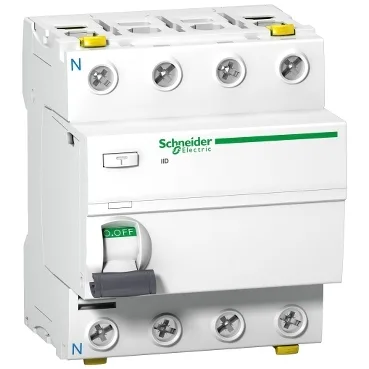
It's a voltage-independent, instantaneous-trip device rated for 40 A continuous current with a 30 mA earth-leakage sensitivity, operating on 380-415 V AC 50/60 Hz networks. The Type A-SI (Super Immunised) classification means it handles sinusoidal AC residual currents plus pulsed DC up to 10 mA, and is designed to resist nuisance tripping from transient surges or high-frequency leakage that can plague variable-speed drives and UPS-fed circuits. That 30 mA sensitivity is the standard for personnel protection in most IEC-based installations. It clips onto a standard DIN rail (35 mm) and fits an 8-module (9 mm pitch) width of 72 mm, with a depth of 73 mm and height of 91 mm. The white housing carries IP20 finger protection on the front and IP40 inside a modular enclosure, so it's meant for a clean, dry panel — not a washdown area.
The 10 kA rated conditional short-circuit current (IEC 61008-1) tells you this RCCB can survive a 10 kA fault on the line side when backed by an upstream overcurrent device of appropriate rating. The 6 kV impulse withstand voltage (Uimp) and pollution degree 3 rating confirm it's built for the typical environment inside a main distribution panel — not a sealed clean room. Rated breaking and making capacity is 1500 A (Idm and Im), which is the short-circuit making/breaking capability of the RCCB itself. The 8/20 µs impulse withstand of 3000 A means it shrugs off lightning-induced or switching surges that would otherwise weld the contacts or damage the sense coil. With 15,000 electrical cycles under AC-1 (resistive) load and 20,000 mechanical cycles, this is a service-life component — not something you swap every year in a normal office or factory panel.
Neutral is on the left, which matters when laying out the busbar order in a multi-pole distribution block. The toggle control has a contact-position indicator and accepts a padlocking device for lockout/tagout. Compliance to EN/IEC 61008-1 and EN/IEC 61008-2-1 covers the European installation standard for residual current protection.