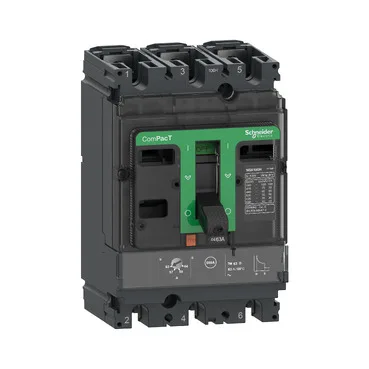
The Schneider Electric C10H3TM025C is a 3-pole ComPacT NSX100H moulded-case circuit breaker with a thermal-magnetic TM-D trip unit rated 25 A at 50 °C. In a 415 V plant network it still holds 70 kA Icu, which puts it in the H breaking-capacity class for this frame size. The TM-D trip gives you thermal overload (L) and magnetic short-circuit (I) protection in one block — no add-on module needed. The magnetic pickup is fixed, so this part suits distribution feeder or branch circuits where the load is predictable and you want a straightforward, reliable trip curve. Mounts on a backplate, not a DIN rail — the 105 mm width and 161 mm height will need a dedicated cutout or mounting bracket in the enclosure. Front connections both top and bottom make for a clean bus-bar layout.
That is the standard you need for a 65 kA or 70 kA rated switchboard. At 440 V it still gives 65 kA; at 500 V it drops to 50 kA; at 690 V it is 10 kA. If the panel runs hotter, the TM-D trip will shift; typical practice is to apply a 0.8 derating factor above 50 °C, but the TM-D is thermal-magnetic, so the thermal element already compensates for ambient changes within the rated range. Power dissipation is 4.01 W per pole, so 12 W total for the three poles — negligible for ventilation planning but worth noting in a sealed enclosure.
Durability and environmental limits
Mechanical endurance is 50,000 cycles; electrical endurance at rated current (25 A, 440 V) is 30,000 cycles. At half load (In/2) that climbs to 50,000 cycles. That is typical for a distribution MCCB — it will outlast the panel in most industrial environments if not cycled daily. The 0–95 % relative humidity range and 2000 m altitude without derating cover most plant-floor and warehouse installations. Above 2000 m you must derate the insulation and breaking capacity per the manufacturer's altitude table.