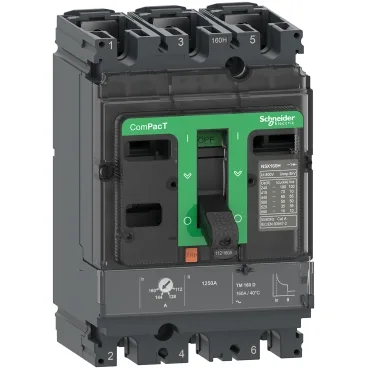
What the 80 A rating means for your panel
The TM-D trip provides fixed long-time and short-time delays, so it's a straight thermal-magnetic curve with no electronic adjustment; you set it once and it protects fixed loads like distribution feeders or non-critical branch circuits. The breaker is rated 690 V AC operational voltage (Ue) and 800 V AC insulation voltage (Ui), per EN/IEC 60947-2, and carries utilisation category A — meaning it's designed for distribution, not motor starting with high inrush. The S breaking capacity code tells you the interrupting rating at 400 V — typically 36 kA for the NSX100S frame, though the exact value depends on the voltage and network configuration. The 3D protected poles description means all three poles are protected; there's no neutral pole on this unit.
Fixed mounting on a backplate, with front connections both upside and downside. The screw terminals accept up to 300 mm² aluminium or copper wire, which is substantial — you'll need a lug kit for that gauge. The 35 mm connection pitch without spreaders matches standard busbar spacing. Control type is a toggle or extended rotary handle; the local signalling gives positive contact indication, so you can visually confirm open/closed state without a meter.
The fixed TM-D trip means no short-time delay adjustment — selectivity with downstream breakers relies on the thermal-magnetic curve's natural I²t region. For full selectivity up to the breaking capacity, you'd typically pair this with a higher-rated upstream device or an electronic trip unit. The 20000-cycle mechanical durability and 10000-cycle electrical durability at rated current (440 V AC) give a reasonable service life for a distribution breaker; at 690 V AC the electrical durability drops to 5000 cycles at In, so factor that in for high-voltage applications.