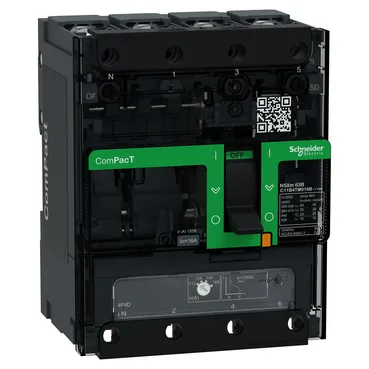
The TM-D trip gives you fixed thermal and magnetic protection; no interchangeable trip blocks, which simplifies spares stocking but means you commit to the 16 A rating at the breaker purchase. Rated 16 A at 40 °C, so in a 40 °C panel ambient it carries the full 16 A continuously. Push the ambient higher and you derate per the IEC 60947-2 thermal curve — common gotcha when the breaker lives next to a transformer or in a non-ventilated enclosure. Category A utilisation means it's not intended for motor starting duty where the breaker sees repetitive overloads close to its thermal curve. This is a distribution breaker — feeder circuits, lighting panels, busway taps, that class of load.
Mounts on a backplate, not a DIN rail — the 108 mm width and 137 mm height footprint matches the NSXm family cut-out. Connection is front-to-front (upside and downside both front), so it panels into a standard switchboard or distribution board layout with busbars or compression lugs. The 35 mm connection pitch with spreaders, 27 mm without, tells you the busbar hole spacing you need. IP40 enclosure face means tools and fingers stay out, but it's not washdown-rated — keep it inside the panel, not on the machine frame. IK07 impact rating handles the odd dropped screwdriver during commissioning. Toggle control, flag indication for auxiliary contacts (green flag when aux contacts are present), and neutral on the left — standard NSXm layout. The 12-module 9 mm pitch (108 mm total) matches the modular width if you're laying out a multi-breaker section.
EN/IEC 60947-2 listing covers the standard for low-voltage switchgear and controlgear circuit breakers. Electrical durability is rated at 20,000 cycles at 440 V at half rated current (In/2), 10,000 cycles at 440 V at full In, and similar curves at 690 V. That's typical for a distribution MCCB — it's not a contactor cycling a motor every minute, but it handles routine switching of a feeder or monthly generator transfer without issue.