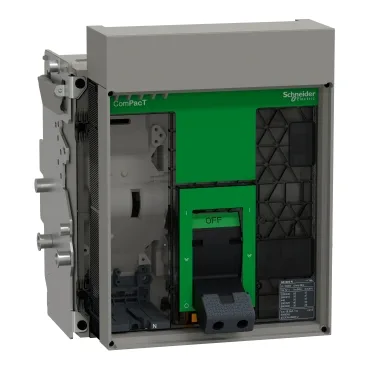
The C160N3WM is a ComPacT NS1600N basic frame — a 3-pole, manually operated, withdrawable air circuit breaker chassis rated 1600 A at 50 °C. It carries no integral trip unit (protection type: without protection), so it is ordered as the frame only; the control unit is specified separately. Per IEC 60947-2, the Ics (service breaking capacity) at the same voltage is 37 kA — the current it can clear and still be expected to carry rated load afterward. That 37 kA Ics/50 kA Icu ratio (75 %) is typical for a distribution-grade frame; the part is sized for main or feeder protection in a 415 V panel where the prospective fault current is known to be under 50 kA.
Withdrawable mounting and panel integration
The withdrawable mounting means the breaker chassis slides into a fixed cradle — the main power connections are made through the cradle, not the moving frame. This allows the breaker to be racked out for maintenance or swap without disturbing the busbars. Mounting support is a backplate; the 70 mm connection pitch matches the standard ComPacT NS630b–1600 cradle footprint. Panel cutout dimensions: 236 mm wide × 260 mm high × 147 mm deep. The IP40 front face and IK07 impact rating are adequate for a protected indoor switchboard environment; the front face carries Class II shock protection, so no additional insulation barrier is required on the operator side.
Durability and environmental limits
Mechanical durability is 10,000 cycles; electrical durability varies by load — 1,000 cycles at In / 690 V, 2,000 cycles at In/2 / 690 V, 2,000 cycles at In / 440 V, and 5,000 cycles at In/2 / 440 V. These are per IEC 60947-2 and represent the maintenance interval for contact inspection, not a hard end-of-life. The 8 kV rated impulse withstand voltage and 19.2 kA short-time withstand current for 1 s define the coordination requirements for the upstream protective device.
Designed and tested to IEC 60947-2. Overvoltage category III and utilization category B are standard for distribution circuit breakers in fixed installations. Power losses at rated current are 154 W — this figure is used for thermal coordination within the enclosure, not for the breaker itself.